Dozen take part in RLC baseball camp

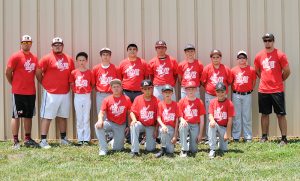
Rend Lake College’s second baseball camp of the summer saw grades 6-8 working on the fundamentals hitting, fielding, pitching, throwing, base running, and mental aspects of the game. The camp was coached by RLC Head Baseball Coach Tyler O’Daniel, far left, volunteer Kaleb Miller, left and volunteer Jake Wylie, far right. Participants in alphabetical order were: Anderson Barker (Mt. Vernon), Colton Berk (Woodlawn), Erik Healy (Enfield), Will Meadows (DuQuoin), Braxton Ragan (McLeansboro), Nathan Ragland (Sesser), Gavin Rogers (DuQuoin), Jake Rogers (DuQuoin), Camden Storm (Bonnie), Drew Wheeler (Mt. Vernon), Robert White (Mt. Vernon) and Dalton Williams (Valier). Click on the image for a larger view.
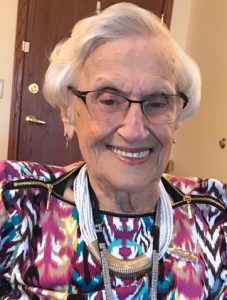
Angeline Cushman – Peoria (formerly of Benton)

Angeline Donosky Cushman, age 94, of Peoria IL,  and formerly of Benton IL, passed away at 2:09 a.m. Monday, July 3, 2017 at her home in Peoria. .
Mrs. Cushman was born on May 21, 1923 in Christopher, IL, the daughter of Theodore Donosky and Dafina (Andreoff) Donosky.  She married Lewis Cushman on August 15, 1943. Together they shared 60 years of marriage together, until Lewis preceded her in death on February 1, 2004.

She along with her late husband owned and operated the Benton Baking Company, until her retirement in 1987.

Mrs. Cushman was a member of the First United Methodist Church of Benton, where she was actively involved in the many lady’s ministries of the church, until she moved with family to Peoria.  She was also a member of the Benton Chapter of Beta Sigma Phi and the Rend Lake Investment Club.

Angeline is survived by her three daughters: Janis and husband Joe Bellamy of Peoria, IL, Connie and husband Ed Peterson of Kingston, IL, Julie Cushman of Conroe, TX; five grandchildren: Joseph Bellamy of Minneapolis, MN, Joshua Bellamy of Peoria, IL, Eric Peterson, Louisville, KY, Chad Peterson, Kingston, IL, Lori Castro of Mount Prospect, IL; and ten great-grandchildren.

She was preceded in death by her parents, husband, a brother Dr. James T. Donosky, a sister Lucille Harvatin, beloved cousins, and a nephew Dr. Ted Donosky.

Funeral Services will be held at 11:00 a.m. Saturday, July 8, 2017 at the First United Methodist Church of Benton with Rev. Jack Wolfe, Rev. Lee Lovett, and Chaplain Bill Cordes officiating. Burial will be in the Masonic and Odd Fellows Cemetery of Benton.

Visitation will be from 9:00 a.m. to 11:00 a.m. Saturday, July 8, 2017 at the First United Methodist Church of Benton.  Arrangements are with the Leffler Funeral Home of Benton.

Memorial contributions may be made to the First United Methodist Church of Benton or to Transitions Hospice of Central, IL.

To leave online condolences to the family, or to share memories of Mrs. Cushman, visit www.lpfuneralhome.com

Rend Lake Fishing Report

From The US Army Corps of Engineers, Rend Lake Project Office

REND LAKE FISHING REPORT  July 3rd, 2017

U.S. Army Corps of Engineers Phone (618) 724-2493 Fax (618) 724-4089 e-mail :  rendinfo@usace.army.mil

Website:   http://www.mvs.usace.army.mil/rend http://www.mvs.usace.army.mil/rend

“Like” us on Facebook at Rend Lake Project Office/Visitor Center

LARGEMOUTH BASS – Good Minnows spinner baits, worms, and black and blue jigs.  Reports of fish being caught around Jackie Branch, Sandusky Cove, and below the dam. Fish in shallow bays near brush cover and bushes. Fish around bridges and along the rocks 14” minimum length limit, 6 daily creel limit. 1 fish daily creel limit in PONDS 14” minimum length.

CRAPPIE – Excellent Meal worms. Small & medium minnows. Quarter-ounce pink and white tub jigs. Shallow water!  Fish attractors!  From shore, fish near structures, hot spots are Jackie Branch, Sandusky, Sailboat Harbor, Marcum coves, and Ina Boat Ramp. Try the Jackie Branch Breakwater and along Mine 21 Road. Fish the main lake drop off areas.  25 fish daily creel limit with no more than 10 fish 10 inches or longer

BLUEGILL – Good Small jigs, worms, meal worms, wax worms, crickets.  From shore try Sailboat Harbor and Mine 21 Road. Try fishing shallow with crickets, worms or small jigs. Fish in the back of necks and on flat shallow banks and on the rocks.  10 fish daily creel limit in PONDS.

CHANNEL  CATFISH – Excellent Large minnows, leeches, Hoss’s Hawg Bait, night crawlers, and Sonny’s stink bait.  Try leeches in moving water.  Drift fish the flats. Set line 3-4’ from the shore over rocks. Try the Waltonville Dam, Turnip Patch, Jackie Branch, and North Sandusky Day Use Area.  6 fish daily creel limit in PONDS. Jugs must be attended at all times while fishing.

WHITE BASS –  Good In-line spinners, jig and curly tail grubs.    Reports of fish being caught around the 154 bridges. Fish around along the rocks and drop-offs Fish in shallow bays near brush cover and bushes. 20 fish creel limit. No more than 3 fish 17” or longer daily

Information as of:  07/02/2017 LAKE LEVEL: 407.63      AVERAGE POOL FOR THIS DATE: 407.48     WATER TEMP:  80°F

Use of a minnow seine, cast net, or shad scoop for bait collecting within 1000 yards downstream of the Rend Lake dam and spillway is prohibited.

Maps of the Fish Attractor tree locations along with GPS readings are available at the Rend Lake Corps of Engineers Project Office.  Contact Randy Cordray for more information at (618) 724-2493.

Logan (Hannaford) High School Rams

http://www.illinoishsglorydays.com/id592.html

LOGAN, IL  (Illinois High School Glory Days.  Please click on the ling above for the full story.  Here is an excerpt below.)

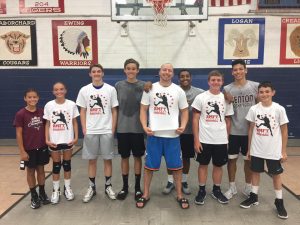
The Logan Grade School gym in 2016. The gym is used for AAU games at times. Center is Dave Brown who recently coached at Carterville High school. This picture was grabbed from long time Logan Grade school coach, and now AAU coach Bobby Melvin’s Facebook page.

Hannaford (population 55) is located in far south-central Illinois in the southeast portion of Franklin County.  County Road 20 is the mnain roadway through Hannaford as Illinois Route 34 passes by the northeast side of town.  The website of www.mapquest.com lists a small hamlet of Logan on the northeast side of Hannaford too.  We are told that Hannaford is also known as Logan and at one time was called Smothersville.  The 2000 Illinois Census only lists the town of Hannaford however.  The population of 55 is disputed as well, there may be about 200 actual residents of Hannaford.

The history of the Logan School in Hannaford is in need of research.  We do know that K – 8 classes were held at the school at one time.  If high school classes were offered, we believe it was probably no more than a two-year high school.  We are in need of your assistance to verify any of this information. 
Logan Grade School competed in the Little 6 Conference.  Different schools were members of the conference over the years, but they included Akin, Ewing-Northern, Thompsonville, Creal Springs, Crab Orchard, Galatia, Pickneyville District 204.  ,Mulkeytown and Hurst-Bush Grade Schools were also members of the conference at one time..

Cardinals recall RHP Luke Weaver from Memphis

Mayers optioned to Memphis

Press Release from the St. Louis Cardinals

The St. Louis Cardinals announced prior to this evening’s game that they have recalled right-handed pitcher Luke Weaver from Memphis (AAA) and that they had optioned right-handed pitcher Mike Mayers to the triple-A club following last night’s game.

Weaver, 23, will be making his 2017 debut with the Cardinals. The former number one draft selection made his majors debut last season, going 1-4 with a 5.70 ERA in nine games (eight starts), totaling 36.1 innings pitched.

Weaver has enjoyed a strong season at Memphis this season, going 7-1 with a 1.93 ERA in 11 games started, allowing just 19 walks and three home runs in his 56.0 innings pitched while striking out 60.

The 6-2, 170-pound Weaver was recently named to the Pacific Coast League All-Star team and he took PCL Pitcher of the Month honors in May when he went 5-1 with a 2.19 ERA in six starts.   He followed up his May performance with a 2-0 mark and 1.59 ERA in four June starts, including an 11-strikeout performance on June 5 at New Orleans.

Weaver, who was the Cardinals number one draft selection (27th player overall) in June of 2014 out of Florida State University, ranks T2nd in the PCL in wins (7) and his 1.93 ERA and .096 WHIP would pace the league if he had enough innings pitched to qualify.

Mayers, who logged 3.0 innings of relief last night, had made two relief appearances with the Cardinals, totaling 4.0 IP, since his June 25 call-up to the majors.

Weaver wears no. 62 and will be in uniform for tonight’s series opener with Miami

The science behind the eclipse

From The National Oceanic and Atmospheric Administration (NOAA)

Before the eclipse, that will bring thousands to Southern Illinois, I will be sharing several news stories and articles about it.  The first is explaining some information about eclipses in general – Steve

What is an eclipse?

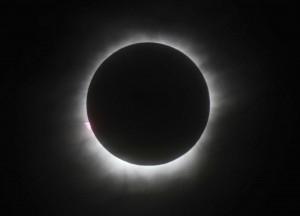
A solar eclipse over Indonesia in March, 2016. (AP file photo)

An eclipse occurs when the Sun, Earth, and Moon move into alignment with each other. One of the bodies blocks the view of another and creates a shadow. There are 2 different types of eclipses: solar and lunar. A lunar eclipse happens at nighttime and occurs when the Earth passes between the Sun and the Moon creating a shadow on the Moon. These types of eclipses occur roughly 2 to 4 times per year. A lunar eclipse will generally last for a few hours.

What To Expect

On Monday, August 21, 2017, all of North America will be treated to an eclipse of the sun. Anyone within the path of totality can see one of nature’s most awe inspiring sights – a total solar eclipse. This path, where the moon will completely cover the sun and the sun’s tenuous atmosphere – the corona – can be seen, will stretch from Salem, Oregon to Charleston, South Carolina. Observers outside this path will still see a partial solar eclipse where the moon covers part of the sun’s disk.

One of the biggest shows of the summer won’t require a ticket. However, the rare total solar eclipse crossing the country on August 21, from Oregon to South Carolina, must contend with the bane of sun seekers: the potential for cloudy weather.

We found that the coasts could be susceptible to cloudier conditions and that increased cloud cover may be possible as the eclipse travels across the country east of the Mississippi RiverHistorically speaking, cloudiness may factor into each location’s chance for a good viewing. NOAA’s NCEI and the Cooperative Institutes for Climate and Satellites–North Carolina (CICS-NC) reviewed past cloud conditions for August 21. We found that the coasts could be susceptible to cloudier conditions and that increased cloud cover may be possible as the eclipse travels across the country east of the Mississippi River.

One of the biggest shows of the summer won’t require a ticket. However, the rare total solar eclipse crossing the country on August 21, from Oregon to South Carolina, must contend with the bane of sun seekers: the potential for cloudy weather.

We found that the coasts could be susceptible to cloudier conditions and that increased cloud cover may be possible as the eclipse travels across the country east of the Mississippi RiverHistorically speaking, cloudiness may factor into each location’s chance for a good viewing. NOAA’s NCEI and the Cooperative Institutes for Climate and Satellites–North Carolina (CICS-NC) reviewed past cloud conditions for August 21. We found that the coasts could be susceptible to cloudier conditions and that increased cloud cover may be possible as the eclipse travels across the country east of the Mississippi River.

One of the biggest shows of the summer won’t require a ticket.  However, the rare total solar eclipse crossing the country on August 21, from Oregon to South Carolina, must contend with the bane of sun seekers: the potential for cloudy weather.

Historically speaking, cloudiness may factor into each location’s chance for a good viewing. NOAA’s NCEI and the Cooperative Institutes for Climate and Satellites–North Carolina (CICS-NC) reviewed past cloud conditions for August 21. We found that the coasts could be susceptible to cloudier conditions and that increased cloud cover may be possible as the eclipse travels across the country east of the Mississippi River

We found that the coasts could be susceptible to cloudier conditions and that increased cloud cover may be possible as the eclipse travels across the country east of the Mississippi River

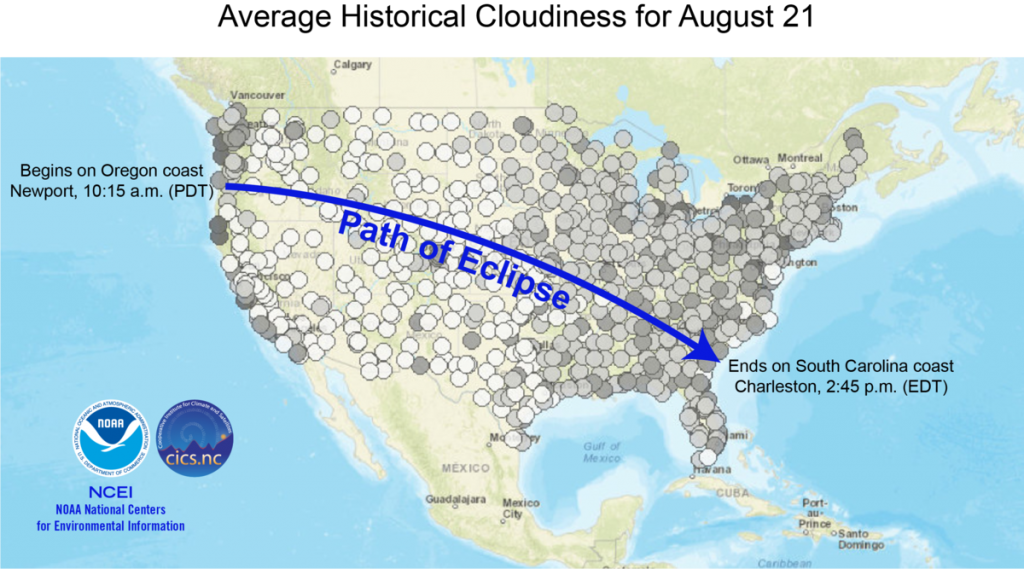
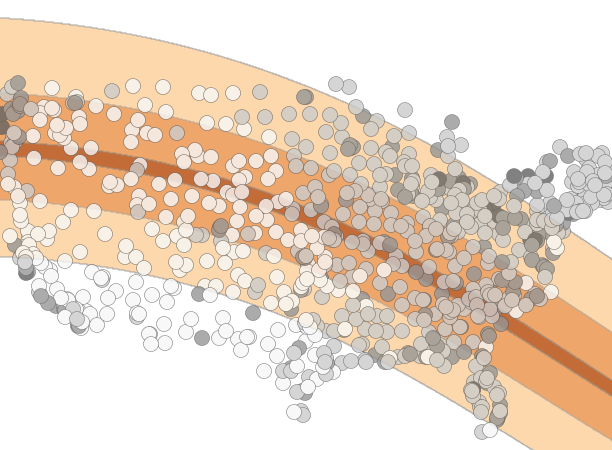
The darker the dot, the greater the chance for cloudiness at the hour of peak viewing during the total solar eclipse on August 21, 2017. Dots represent automated weather stations that reported the cloudiness data and show the 10-year cloudiness average for August 21, 2001–2010. Map developed by CICS-NC in cooperation with NOAA NCEI, Deborah Riddle. Notice that over this time, Southern Illinois has the least chance of cloudiness.

Although the picture doesn’t particularly bode well at the coasts of Oregon and South Carolina, the chance for clearer skies appears greatest across the Intermountain West. If historical conditions hold true, Rexburg, Idaho, a two-hour drive west of Wyoming’s Grand Teton National Park, has a good chance for clearer skies. Casper, Wyoming, also holds promise. Other historically clear locations include Lincoln, Nebraska, and Carbondale, Illinois.

Historical cloudiness increases as the path curves southeastward across the Plains, making viewing the rare event potentially rarer as it moves toward the East Coast. This is the first time since 1979 that a total eclipse has crossed the United States and the first time since 1918 that one will travel coast to coast. Everyone in the 50 states will be able to experience at least a partial eclipse, depending on weather, but no other country falls in the path of the total eclipse.

Try Our Interactive Eclipse Map

Our interactive map provides greater detail about viewing the eclipse across the nation. The map lists a “viewable” percentage for each reporting location. The viewable percentage represents the likelihood of skies being clear enough for the eclipse to be visible. A higher percentage means a viewer is more likely to have a view unobstructed by clouds. Also, a bar chart shows the probabilities for five types of cloud cover: clear (no clouds), few, scattered, broken, and overcast. Percentages are derived from averages of each type of cloud cover.

Only an estimated 12 million people live within the relatively narrow area of the total eclipse. (NOAA map)

Take Newport, Oregon, for instance, the first land-based weather station location in the path of the full eclipse. The eclipse will occur there at approximately 10:15 a.m. local time (17:15 UTC). The viewable percentage is 44 percent, meaning there’s a 56 percent chance that viewability will be adversely affected by clouds. Keep in mind the percentage is an estimate of average conditions, not a guarantee for this year.

Only an estimated 12 million people live within the relatively narrow area of the total eclipse. However, several major cities and five state capitals fall within the path of totality—the narrow band where the moon completely blocks the sun’s face. Visit the CICS-NC interactive map (link is external) to search for an optimal viewing location by zip code.

Find a Seat for the Total Eclipse

From its first appearance over the Pacific Northwest in midmorning, the eclipse will last approximately 90 minutes, ending shortly after 2:45 p.m. local time (18:45 UTC) on the South Carolina coast near Charleston. Here’s a partial list of towns and cities on the path of totality from west to east along with estimated local times for peak viewing of the total eclipse, followed by the average historical cloudiness percentage (state capitals in bold; asterisks indicate larger airports):

Illinois Carbondale 1:19 p.m. (CDT) 80%
Kentucky Paducah 1:22 p.m. (CDT) 77%


Chesterfield near St. Louis 1:16 p.m. (CDT) 61%


Eclipse Essential: Protect Your Eyes

The eclipse should only be viewed with protective eyewear designated for use during an eclipse. Ordinary sunglasses or 3D glasses lack sufficient protection.  It’s important to take precautions when viewing the eclipse. The partial phases of the eclipse can last between 2 to 3 hours; at its longest, the total eclipse will last 2 minutes and 40 seconds.

Direct viewing of the partial phases can cause permanent damage to your eyes because of the intensity of the sunlight. The eclipse should only be viewed with protective eyewear designated for use during an eclipse. Ordinary sunglasses or 3D glasses lack sufficient protection. Also, avoid viewing through unfiltered cameras, telescopes, binoculars, or other optical devices.

However, if weather cooperates during the few minutes that the sun is completely eclipsed in totality, the brief interval is as safe to view as a full moon.

Safety Precautions

Looking directly at the Sun is unsafe except during the brief total phase of a solar eclipse (totality), when the Moon entirely blocks the Sun’s bright face, which will happen only within the narrow path of totality.

The only safe way to look directly at the uneclipsed or partially eclipsed Sun is through special-purpose solar filters, such as eclipse glasses or hand-held solar viewers. Homemade filters or ordinary sunglasses, even very dark ones, are not safe for looking at the Sun. To date four manufacturers have certified that their eclipse glasses and handheld solar viewers meet the ISO 12312-2 international standard for such products: Rainbow Symphony, American Paper Optics, Thousand Oaks Optical, and TSE 17.

Always inspect your solar filter before use; if scratched or damaged, discard it. Read and follow any instructions printed on or packaged with the filter. Always supervise children using solar filters.


  • Stand still and cover your eyes with your eclipse glasses or solar viewer before looking up at the bright Sun. After glancing at the Sun, turn away and remove your filter — do not remove it while looking at the Sun.
  • Do not look at the uneclipsed or partially eclipsed Sun through an unfiltered camera, telescope, binoculars, or other optical device. Similarly, do not look at the Sun through a camera, a telescope, binoculars, or any other optical device while using your eclipse glasses or hand-held solar viewer — the concentrated solar rays will damage the filter and enter your eye(s), causing serious injury. Seek expert advice from an astronomer before using a solar filter with a camera, a telescope, binoculars, or any other optical device.
  • If you are within the path of totality, remove your solar filter only when the Moon completely covers the Sun’s bright face and it suddenly gets quite dark. Experience totality, then, as soon as the bright Sun begins to reappear, replace your solar viewer to glance at the remaining partial phases.


An alternative method for safe viewing of the partially eclipsed Sun is pinhole projection. For example, cross the outstretched, slightly open fingers of one hand over the outstretched, slightly open fingers of the other. With your back to the Sun, look at your hands’ shadow on the ground. The little spaces between your fingers will project a grid of small images on the ground, showing the Sun as a crescent during the partial phases of the eclipse.

A solar eclipse is one of nature’s grandest spectacles. By following these simple rules, you can safely enjoy the view and be rewarded with memories to last a lifetime.

Understanding the Historical Cloudiness Data

Our historical cloudiness data come from 10-year hourly climate normals for 2001–2010 measured at automated weather stations across the country on August 21, as close to the hour of the eclipse as possible. Availability of data determined the number of usable stations. The period 2001–2010 was chosen because a nationwide network of automated observing stations became operational in 1998. This 10-year timeframe allowed hourly normals computation for more than 800 stations.

However, many factors can influence cloudiness. Areas that experience higher humidity, such as coastal Oregon and the Southeast, are more likely to experience cloudy conditions. Other local factors may influence cloudiness and viewability as well, such as mountains and fog. Afternoon convection can also cause pop-up showers and storms. This helps explain the lower viewable percentages over the eastern half of the United States when the eclipse passes through early to midafternoon.

Keep a few other caveats in mind as you look at our maps. Automated weather stations only view clouds from the surface to 12,000 feet. Larger airports also typically have two cloud sensors (ceilometers) whereas smaller airports may only have one. Larger airports often have human observers that can see higher clouds. These differences mean that stations at larger airports tend to detect more clouds, so stations near each other may report different viewability percentages.

Ultimately, the cloudiness calculations are based on past observations, which are no guarantee of future outcomesUltimately, the cloudiness calculations are based on past observations, which are no guarantee of future outcomes. For predictions of actual conditions closer to the day of the eclipse, check your location’s forecast at NOAA’s Weather.gov as early as seven days prior to the event.

As Brady Phillips of NOAA’s Office of Communications notes, “Even the driest places on Earth experience clouds, fog, and rain.


50 INFLUENCERS OF REND LAKE COLLEGE: MILLIE CALDWELL, MATRIARCH OF GENEROSITY

by Reece Rutland- Rend Lake College Public Information/Sports Information Director

INA, IL – Three decades of service. Three decades of unselfish giving. Verna Mildred “Millie” Caldwell has enthusiastically supported Rend Lake College and its students for a length and breadth that is nearly unparalleled in an already distinguished lineup of supporters.

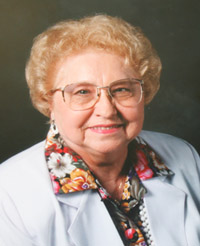
Millie Caldwell – (All pictures provided by Rend Lake College

Caldwell and her husband Clifton were already community staples outside of their involvement with RLC. For years, the couple operated one of the area’s most successful newspapers, The Christopher Progress. In fact, the Caldwells purchased the two Southern Illinois papers in 1974 (the Progress and the Herrin Spokesman) and ran them for over a decade, eventually selling them in 1987 to the American Publishing Company newspaper chain.

Cliff passed away on Feb. 29, 2004. He was a well-known journalist for 46 years and a member of the Southern Illinois University Editors Hall of Fame. Together, Clif and Millie instituted zoned editions of their weeklies that provided published local news for the communities of Sesser, Zeigler, Royalton, Johnston City and Carterville, as well as the communities included in their names. They had been married for 61 years.

To commemorate Cliff’s legacy, the family banded together to create the Clifton Caldwell Endowment Scholarship for Rend Lake students. The scholarship looks to help a Journalism or Math major in need.

The Foundation was the natural fit; Millie had spent the better part of three decades doing everything she could to aid the RLCF and the students of RLC.

Caldwell has represented the Christopher locality on the RLCF Board since 1982 when she elected at 4th Annual Meeting to bring the board to nine members. She had been an integral part of three capital campaigns. She was a major part of the RLCF Children’s Center campaign and the RLC Music Program Addition and Theatre Renovation. All of that on top of the fact that she has donated toward RLCF scholarships for years.

But, it was never just money either. Both Millie and Cliff gave of their time. The Caldwells actively attended RLCF events throughout the years. He was a frequent player at annual RLCF Golf Tournaments and they regularly attended the RLCF Annual Dinner together. Millie was also frequently at the RLCF Women’s Luncheon and RLCF Scholarship Dinner.

In 2002, Millie was recognized by the Rend Lake College Foundation Board of Directors when the group enthusiastically and unanimously approved her for Emeritus status.

She earned it. Her support of the college through Foundation efforts is, without a doubt, significant. And her length of service to the organization is nearly unmatched. Only three other members hold Emeritus status on the board – Charter Director Howard L. Payne and former Rend Lake College President Mark S. Kern and long-time foundation board member and Sesser businessman George Slankard.

“This honor is reserved for members because of longevity and lasting contributions made to the RLC Foundation,” explained Pat Kern, RLCF consultant and former CEO.

“This status welcomes these selected Board members to the RLCF meetings at any time they wish to attend.”

It’s not the first honor Millie has received for her service.

She also earned the coveted RLCF Presidential Award in 2006. It’s an achievement set aside specifically for RLCF Board members who have displayed exceptional service.

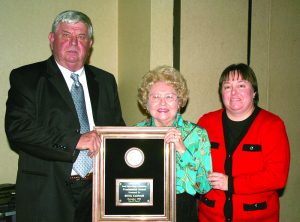
Millie Caldwell (center) accepts the Presidential Award from then RLC President Mark Kern (left). She was joined by her daughter, and RLC Professor Cindy Caldwell (right).

For her numerous scholarship contributions, she has also been presented the RLCF Bronze Seal Award, an achievement also shared by her daughter Cindy.

In fact, the Math component of the Clifton Caldwell Endowment Scholarship stems from Cindy’s willingness to pick up her family’s legacy and continue the giving tradition. She is a Mathematics Professor who joined the Rend Lake College faculty in 2000. She also is a graduate of Rend Lake College (Class of 1980) who worked on the RLC Times student newspaper. The Caldwells also had three sons – Denis, Dave and Douglas.

“Like many of our influencers, Millie and the Caldwell family display a selflessness that has helped the institution become what it is today. We are able to do the things we do thanks to the generosity of people like Millie, people who care about the district’s students and want to see them succeed,” said RLC President Terry Wilkerson.


Christie flying by state chooper to state park amid shutdown

NOTE:  Illinois is not the only state having budget impasse problems.  Eleven states are, including New Jersey.

TRENTON, NJ  –  (Michael Catalini and Bruch Shipkowski, the Trentonian.  Please click on the link above for the full story.  Here is an excerpt below.)

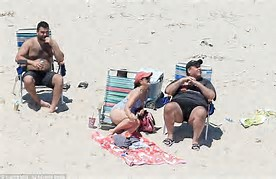
New Jersey Republican Gov. Chris Christie lounged on the beach with his family Sunday afternoon before flying on a state helicopter to Trenton and back again to the shuttered state park where his family is staying at the state-owned governor’s residence there amid a government shutdown that showed little sign of ending.

Christie lounging on a New Jersey beach, which is part of a state park that is closed. His beach house is located around the state park. (Daily Mail photo.)

Christie said Sunday at a news conference in Trenton where he worked without result to end the shutdown that he flew on the state chopper to the residence at Island Beach State Park.

“That’s where my family is sleeping so that’s where I’ll sleep,” he said. “When I have a choice between sleeping with my family or sleeping alone, I generally like to sleep where my family is.”

Cubs right-handed reliever Wade Davis elected to N.L. All-Star team

Third baseman Kris Bryant on the N.L. Final vote ballot

Press release from the Chicago Cubs

Chicago Cubs right-handed reliever Wade Davis was today elected to the 2017 National League All-Star team. Davis has earned the third All-Star selection of his major league career, his first in the National League.

Davis will represent the Cubs at the 88th Major League All-Star Game Tuesday, July 11 at Miami’s Marlins Park. Davis was elected to the N.L. squad by way of the player vote.

Third baseman Kris Bryant is one of five players up for vote on the N.L.’s Final Vote ballot.

Davis has been named to his third-consecutive All-Star team, as he represented the Kansas City Royals as a member of the American League squad in 2015 and 2016. He is the first Cubs relief pitcher to make the team since both Carlos Marmol and Kerry Wood represented the club in 2008. Davis is the first Cubs pitcher to make the All-Star team in his first season with the club since Mitch Williams in 1989.

In 2017, Davis is a perfect 16-for-16 in save chances to go along with a 2-0 record, 1.93 ERA and 0.96 WHIP in 29 relief outings. He has struck out 42 batters in 28.0 innings, an average of 13.5 strikeouts per nine innings, while limiting opponents to a .170 batting average, including a .115 mark by left-handed hitters and a .229 mark by right-handed hitters. He began his Cubs career by not allowing an earned run in his first 18 outings, surrendering only six hits in that period that spanned 17.1 innings pitched.

Bryant is aiming for his third-straight All-Star appearance in his third major league campaign, as he would become the first Cubs third baseman to earn honors in three-consecutive campaigns since Ron Santo from 1971-73. Bryant is the first Cubs player to be up for election for the All-Star team via the Final Vote ballot since Anthony Rizzo in 2014, who was overwhelmingly elected to represent the Cubs that summer.

The reigning National League Most Valuable Player, Bryant is batting .263 (73-for-278) with 17 doubles, two triples, 16 home runs and 32 RBI in 76 games this season.

In addition to Bryant, the 2017 Esurance MLB All-Star Game Final Vote for the National League includes first baseman Justin Bour of the Marlins; third baseman Anthony Rendon of the Nationals; first baseman Mark Reynolds of the Rockies; and third baseman Justin Turner of the Dodgers. Fan balloting is available now and concludes on Thursday, July 6th at 4:00 p.m. ET. Now in its 16th season with over 680 million votes cast, fans again will be able to make their Final Vote selections on MLB.com, Club sites and their mobile devices.  The winners of the Final Vote will be announced live on MLB Network’s MLB Tonight on Thursday, July 6th at 6:00 p.m. ET.

In addition to MLB.com and the official club websites, fans may use their mobile devices to cast ballots at MLB.com/vote. For the sixth consecutive year, the last day of the Esurance MLB All-Star Game Final Vote also will include social balloting, as Twitter support from the 10 candidates’ fans over the last six hours of balloting will count toward their final vote totals. From 10:00 a.m.-4:00 p.m. (EDT) on Thursday, July 6th, any tweet that includes a designated player hashtag will be tabulated as part of the official vote total used to determine the AL and NL winner.


Homestand Highlights – July 1st vs the Miami Marlins

Press release from the St. Louis Cardinals

Monday, July 3, 2017 – Cardinals vs. Miami Marlins (6:15 p.m.)
Gates open at 4:45 p.m.

  • Fireworks Night: Stay in your set after the game to watch a dazzling fireworks display with the St. Louis Arch as the backdrop. Presented by Cooper Tires. (#CardsPromo)
  • Honorary First Pitch: NBA Champion and Golden State Warriors rookie Patrick McCaw, a St. Louis native who played basketball at Christian Brothers College (CBC) High School, will throw out a ceremonial first pitch before tonight’s game.
  • MLBPAA Auction: The Major League Baseball Players Alumni Association will conduct a baseball-themed silent auction by Gate 1 (Section 137) and Gate 3 from the time gates open through the fifth inning. All proceeds will benefit Cardinals Care and the Players Alumni Association, a non-profit group that strives to preserve the game of baseball while supporting a variety of charities.
Benton, West Frankfort, Illinois News | Franklin County News