Jefferson County Chamber of Commerce creates endowed scholarship at RLC

INA, Ill.– Members of the Jefferson County Chamber of Commerce (JCCC) are making lasting impacts on their local community with the recent creation of a $10,500 scholarship to the Rend Lake College Foundation.

The announcement was made last week during the JCCC Annual Dinner by Board President Tony Wielt. The majority of the donation – $10,000 – will create an endowed scholarship that will begin awarding in the 2019-2020 academic year and will continue in perpetuity.

“We believe in Rend Lake College as a partner in education. We know we have the resources right now to be able to make an investment that will be able to help a student in Jefferson County to improve their education now and into the future,” said Wielt. “We may never be in a position like this again to be able to financially help a student. I’m honored to be able to do this: to serve as the Board President this year and make this announcement has been one of the best things the Chamber has allowed me to do. The decision this Chamber made will still be helping people 20 years from now, and that’s a great feeling.”
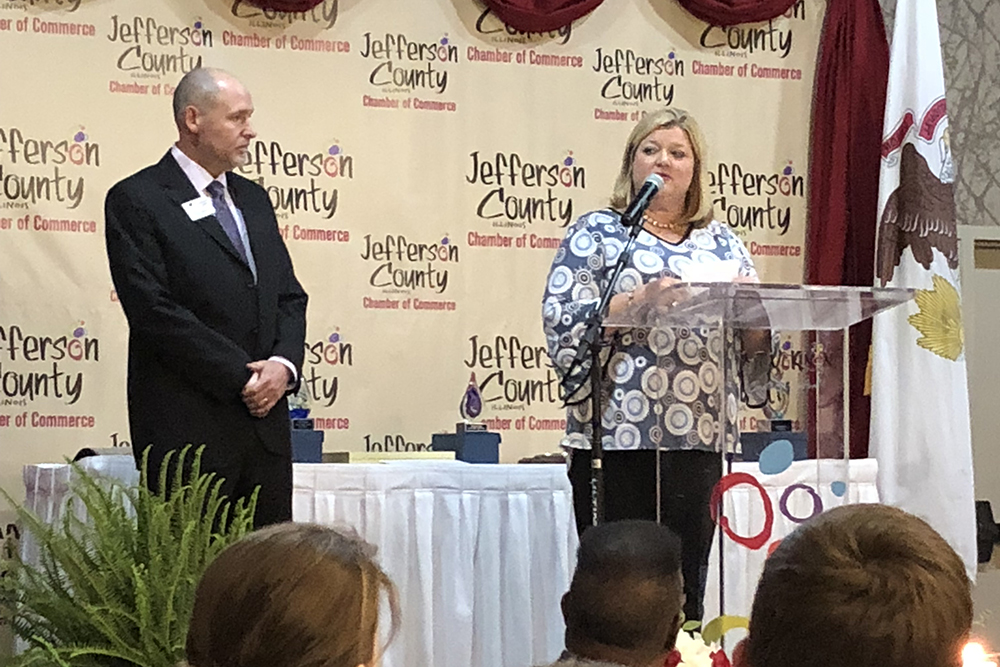
Wielt ZibbyDamron ChamberDinner2018W

Tony Wielt, LEFT, Board President of the Jefferson County Chamber of Commerce, and Kay Zibby-Damron, RLC Foundation CEO, announce the creation of an endowed scholarship by the JCCC during the Chamber’s Annual Dinner last week. The endowment will provide scholarship funds for students in perpetuity. Click on the image for a larger view.
(Photo: Jefferson County Chamber of Commerce)

The JCCC was able to create the endowed scholarship thanks to a boom in the local business market. Wielt explained the increase in memberships has allowed the Chamber to invest both internally and externally.

“A couple of things have happened over the last three years with the Chamber. The first being that our membership has grown significantly and, as a result, we have been able to make two big investments with the resources we have generated in memberships and sponsorships,” said Wielt. “One of those investments is the endowment, and the second is the additional personnel we’ve added to support a membership of nearly 500 businesses. It’s fantastic. The business climate in Jefferson County is improving every year, and these investments are a direct reflection of that.”

The endowment itself is the result of the organization’s interest in providing more financial assistance to local students. Additionally, the donation amount places the JCCC on the Major Donors Wall, located in the RLC Student Center on the Ina campus.

“We have a lot of members in the Chamber who have a heart for education,” said Wielt. “When I was meeting with Kay Zibby-Damron (RLC Foundation CEO) last fall about my personal scholarship, I said, ‘wouldn’t it be nice for the Chamber to do something like this,’ and it evolved from there. We had more and more people involved and had everyone’s full support.”

“We truly appreciate what the Jefferson County Chamber of Commerce has done and we value our partnership with them,” said RLC President Terry Wilkerson. “Helping a local student get a college education is a great way to invest in the community. Hopefully, those students will want to return to the area and contribute in their own way, whether that’s by joining the workforce or starting a business of their own.”

The remaining $500 of the donation will provide a scholarship for one deserving student in the 2018-2019 academic year. Because endowment investments take one year to mature, the JCCC would’ve had to sit out this upcoming year without the additional contribution.

“When we decided we wanted to make this investment for an endowed scholarship, we realized we wouldn’t be able to recognize a student until the fall of 2019, so we decided then to make an additional $500 investment so we could begin in the fall of 2018,” said Wielt.

The awarding criteria set by members of the JCCC is for any RLC student who resides in Jefferson County. Wielt said the members of many different committees decided not to limit students from applying.

“Members of the Chamber had lots of questions regarding choosing students and the parameters for the scholarship, but we landed on a broad opportunity. Applicants can be non-traditional or just out of high school, with no specific major. They just have to be a Jefferson County resident. It’s an equal opportunity for all who apply,” said Wielt.

In the end, the Chamber recognizes the importance of giving back to the community by giving back to those working hard for a new career, entrepreneurship, or advanced skills in their current workplace.  

“We truly believe in the community partnership of Rend Lake College. We have a common belief that it’s important to invest in your community. In fact, we speak about that among our membership. We want to help people as they complete or continue their education,” said Wielt. “To have students recognize it was local businesspeople and community leaders who helped support them, it’s fantastic.”

Kay Zibby-Damron, RLC Foundation CEO, echoed Wielt’s statement by saying the donation can be seen more as an investment in the local community.

“This generous investment is a testament that the Greater Jefferson County Chamber of Commerce values education and wants to change lives in our community for the better,” said Zibby-Damron. “This new scholarship will give life to dreams for many Jefferson County students for years to come. The RLC Foundation is very thankful to have the support of individuals, businesses, and organizations throughout our district who partner with us to provide more and more opportunities for our students to receive an affordable and quality education.”

Students can learn more about the scholarship by contacting the RLC Foundation at 618-437-5321, Ext. 1214.

SIU Board votes down Carbondale-to-Edwardsville funding shift

Southern Illinois University Carbondale constituents erupted in applause Thursday as the SIU Board of Trustees voted down a proposal to shift $5.1 million in state appropriation funding to SIU Edwardsville.

Here’s a link to the story in the Southern Illinoisan.

Report: Many state pension systems have huge funding gaps

CHERRY HILL, N.J. — A public employee pension crisis for state governments has deepened to a record level even after nearly nine years of economic recovery for the nation, according to a study released Thursday, leaving many states vulnerable if the economy hits a downturn.

The massive unfunded pension liabilities are becoming a real problem not just for public-sector retirees and workers concerned about their future but also for everyone else. As states try to prop up their pension funds, it means less money is available for core government services such as education, public safety and parks.

The annual report from the Pew Charitable Trusts finds that public worker pension funds with heavy state government involvement owed retirees and current workers $4 trillion as of 2016. They had about $2.6 trillion in assets, creating a gap of about one-third, or a record $1.4 trillion.

While the study looks only at pension funds with major state-government involvement, systems run by cities, counties, school districts and other local entities have had similar problems. Just this week, the Chicago suburb of Harvey, a city with a history of underpaying its pension obligations, announced deep layoffs in its police and fire departments. Officials blamed their rising pension obligations.

Larger cities and school districts across the country also have had service cuts or freezes over the years to pay for rising costs for their retirees.

Pew says that pension funds were well-funded until about 2000. Around that time, many states increased pension benefits without a way to pay for them. In some states, such as California and Illinois, courts usually find that the government must honor those commitments.

Also in the early 2000s, the tech stock bubble burst, spiraling investment returns downward. Some states, such as New Jersey, made things worse by skimping on their contributions.

Many pension funds had not recovered from the dot-com bust by the time the Great Recession hit less than a decade later. And many haven’t recovered from that, either.

“When the next downturn comes, there will be additional pressures,” David Draine, a senior officer at Pew, told The Associated Press.

Colorado, Connecticut, Illinois, Kentucky and New Jersey had less than half the assets they needed to meet their pension obligations, according to the report. Kentucky and New Jersey have the largest gaps, with just 31 percent of the needed funding.

Kentucky has been roiled by weeks of protests over a bill passed by the Republican-dominated Legislature and signed by the Republican governor that makes changes to the state’s teacher retirement system in an attempt to close the funding gap. Teachers have packed the state Capitol by the thousands to protest the changes. On Wednesday, they joined the state’s attorney general, a Democrat, in filing a lawsuit seeking to overturn the law.

Just four states — New York, South Dakota, Tennessee and Wisconsin — had at least 90 percent funding. Draine said those states and some others that have repaired pension shortfalls since the Great Recession will be in better shape the next time the economy slides.

 The Pew report found that lackluster investment returns in 2016 explained most of why the condition of pensions declined from the previous year. Pension administrators were counting on median returns of 7.5 percent that year. Instead, they made just 1 percent.

But the study says that even if the investments had met expectations, the overall position of pension funds still would have declined because state governments were not contributing enough. Only Kansas contributed more to its pension system in 2016 than it paid out, Pew found.

In New Jersey, actuaries say it will take around $6 billion a year in contributions from the state to shore up its pension system. It’s taken years to get to less than half that amount in the current budget. Maintaining that progress makes it difficult to pay for other priorities, such as boosting school funding.

The study finds that states increasingly rely on investment returns in an attempt to stabilize their finances, which makes them more vulnerable to market fluctuations.

Because of a strong market last year, next year’s report, which will assess the state of pensions as of 2017, is expected to look better. But market slides so far this year have not been encouraging, Draine said.

Illinois will send national guard troops to border if requested


Count Illinois National Guard troops in for guarding the nation’s southern border, if an official request is made by the Trump administration. President Donald Trump announced using guard troops to assist border patrol agents along the U.S.-Mexico border to stem the flow of illegal immigration.

Here’s a link to the story.

Governor Rauner requests federal assistance to help people recover from February floods

Request includes Iroquois, Kankakee and Vermilion Counties


SPRINGFIELD – Gov. Bruce Rauner today asked President Donald Trump to approve federal assistance to help people in Iroquois, Kankakee and Vermilion counties recover from severe storms and flooding in February. 

“Many people affected by this flood event face a difficult road to recovery,” Rauner said. “Federal assistance is needed to help them repair their homes and replace personal property that was destroyed.”

Rauner noted that for many residents of Watseka, the February flood marked the third significant flood event they’ve experienced in the last three years, and the fourth in the past 10 years.

Joint assessment teams from the Illinois Emergency Management Agency (IEMA), the Federal Emergency Management Agency (FEMA) and the U.S. Small Business Administration (SBA) reviewed damage in the three counties in March. Nearly 1,100 residences were impacted during this event, including 157 homes found to have sustained major damage and one home that was destroyed.

If Governor Rauner’s request for Individual Assistance is approved, people in the approved counties would be eligible to apply for grants and low-interest SBA loans. In addition, affected businesses would be able to apply for low-interest SBA loans.

Op-Ed: Illinois’ crushing property tax burden needs bipartisan solution

In Illinois, property taxes shouldn’t be a blue vs. red issue.

Here’s the link at Illinois News Network.

Legislative leaders talk revenue, budget process

A cuts budget, or a no-cuts budget? Either way, whatever Illinois lawmakers pass before the May 31 deadline is likely to include all of the $5 billion income tax increase passed over the governor’s veto last summer.

Here’s the link at Illinois News Network.

FCN Daily Bible Verse

I want to know Christ and the power of his resurrection and the fellowship of sharing in his sufferings, becoming like him in his death.
Philippians 3:10 (Read all of Philippians 3:10)
New International Version

Joshu makes first court appearance, bond set at $1 million

Bond has been set at $1 million for Phillip Joshu, a 37-year-old Decatur man, accused of having a large amount of illegal drugs in his possession and leading local law enforcement authorities on a high-speed chase on April 5.
Joshu made his initial court appearance Wednesday morning in Franklin County Circuit Court where he is facing eight felony charges stemming from the dangerous pursuit that reached speeds in excess of 100 miles per hour. When Joshu was finally apprehended the following morning on the southeast side of Benton he still had in his possession a large cache of illegal drugs that included two pounds of “crystal” meth, 100 “hits” of LSD, 30 grams of mushrooms and a half pound of marijuana. Police also found one handgun in his possession and another that he threw from his vehicle while police were in pursuit. The methamphetamine had a street value of $80,000.
Franklin County Public Defender Kevin Popit was appointed to represent Joshu and during a brief court appearance asked Judge Eric Dirnbeck to reduce bond. Troy Wise, assistant state’s attorney, argued that the bond should remain at $1 million, citing Joshu’s lengthy criminal history that includes a conviction for second-degree homicide in Macon County in 1999 and two other weapons charges. Wise also pointed out that Joshu was a “serious flight risk” noting that he drove his vehicle on railroad tracks before fleeing on foot and that he had to be tasered before he could be taken into custody. Judge Dirnbeck denied the motion to reduce bond.
Joshu was stopped on a routine traffic stop for speeding on April 5 in West Frankfort while he was traveling northbound on Route 37. When the officer approached the vehicle he noticed a handgun in the floorboard and told Joshu to exit the car. Instead, Joshu sped off with the officer in pursuit and speeds exceeded 100 miles per hour during the six mile distance to Benton, where authorizes there were asked to assist. Joshu turned off Route 37 on to Hudelson street toward Benton Community Park.
Near the point where Hudelson Street intersects with South Du Quoin Street Joshu turned his vehicle on to railroad tracks and drove a short distance before the car became stalled. He then fled on foot into a wooded area near the Benton Park. Officers from West Frankfort, West City, Franklin County Sheriffs Office, Illinois State Police, Christopher and Benton responded, conducting searches and investigating leads throughout the night. 
At approximately 7:45 a.m. the following morning (April 6) an officer from the West City Police Department spotted Joshu on Greenwood Street, on the southeast side of Benton. Officers from the Franklin County Sheriff’s Department, West City and Benton ultimately located Joshu near the 1000 block of South McLeansboro where he was taken into custody. The 6-feet-3, 240 pound Joshu resisted arrest and had to be tasered before he was finally subdued and arrested. The same morning as the arrest was made, an Ameren employee reported finding a handgun just off Route 37 south of Benton.  The gun was a .45 caliber pistol later determined to be stolen out of Christian County, IL.

Joshu is facing eight felony counts including two Class X felonies, four Class 3 felonies and two Class 4 felonies. A conviction on a Class X felony carries a penalty of mandatory prison time with a sentencing range of six years minimum and 30 years maximum. One of the Class X felonies Joshu is facing is enhanced and carries a penalty of mandatory prison time with a sentencing range of a minimum of 12 years and a maximum of 60 years.
Joshu is scheduled to be in court again on April 25 for a preliminary hearing.

Pastor Rick Warren: Make Time to Be Quiet

Make Time to Be Quiet

04-12-18-Hearing-Gods-Voice-Make-Time-To-Be-Quiet_preview

“Find a quiet, secluded place so you won’t be tempted to role-play before God. Just be there as simply and honestly as you can manage. The focus will shift from you to God, and you will begin to sense his grace” (Matthew 6:6 The Message).

God isn’t going to speak to you if your life is filled with a bunch of noise. You’ve got to get alone, and you’ve got to get quiet. We call this a quiet time.

Jesus says it like this in Matthew 6:6: “Find a quiet, secluded place so you won’t be tempted to role-play before God. Just be there as simply and honestly as you can manage. The focus will shift from you to God, and you will begin to sense his grace” (The Message).

Here’s the key to hearing God speak and getting his vision for your life: God wants to meet with you.

You need to realize you’re not waiting on God; he’s waiting on you. God made you to have a relationship with him. He wants you to spend time with him on a daily basis. He wants you to schedule a date with him every day. God is waiting.

Getting alone in a quiet place is pretty difficult today. I don’t know if you realize how much noise there is in your life. You’ve always got the radio on in the car or you’ve got earbuds in or Bluetooth turned on. Every waiting room, grocery store, and elevator has music. There’s very little time or space in your life that’s absolutely quiet.

If you’ve got kids at home, it’s even more difficult! But let me give you some hope. Susanna Wesley, one of the great women of history, had 18 children. One of her sons, John, founded the Methodist church and helped spread Christianity across America, and another, Charles, wrote more than 6,000 hymns.

How do you find time alone when you have 18 children? In her biography, it says that Susanna Wesley would sit in her favorite rocker every afternoon, and she would throw her apron over her head for an hour. Her kids knew that Mom with apron over her head meant, “No child bothers Mom or you face the consequences!”

Wesley said it was the prayers of his mom that shaped his life. You can find time alone if you are that desperate. Make time to be quiet and meet with the Lord.

Benton, West Frankfort, Illinois News | Franklin County News