Several new and updated driving laws go into effect in Illinois on New Year’s Day.
Here’s a link to the story at Illinois News Network.
Benton, West Frankfort, Illinois News | Franklin County News
Newspaper covering Franklin County, Illinois
Several new and updated driving laws go into effect in Illinois on New Year’s Day.
Here’s a link to the story at Illinois News Network.
By Jim Muir
Christmas traditionally is a time for wide-eyed children, exchanging gifts and festive family get-togethers. For many, though, it also is a time that serves as a grim reminder of the worst tragedy in the history of Franklin County.
On Friday, Dec. 21, 1951, at about 7:35 p.m. a violent explosion ripped through Orient 2 Mine, located near West Frankfort, claiming the lives of 119 coal miners. The tragedy occurred on the last shift prior to a scheduled Christmas shutdown. News of the tragedy spread quickly from town to town and hundreds of people converged on the mine to check on loved ones and friends.
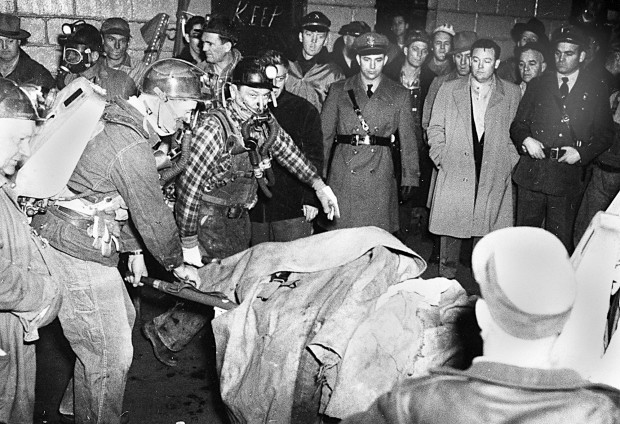
Rescue workers are pictured with one of the 119 miners killed on Dec. 21, 1951 in the Orient 2 explosion.
A basketball game was under way at Central Junior High School in West Frankfort, when the public address announcer asked that Dr. Barnett report to Orient 2 Mine, No. 4 Portal, because “there had been a catastrophe.” There were about 2,000 people at the game, and nearly half of them left with Dr. Barnett. News of the tragedy and massive loss of life drew nationwide attention. Both Time Magazine and Life Magazine featured accounts of the explosion and newspapers from throughout the country sent reporters to Franklin County to cover the holiday tragedy. Gov. Adlai Stevenson was at the mine the following day along with volunteers from the Red Cross and Salvation Army. Those who arrived at the Orient 2 Mine immediately after reports of the explosion surfaced had no way of knowing that they would be a part of history and folklore that would be handed down from family to family for decades to come.
A Christmas Miracle
Rescue workers began entering the mine within hours of the explosion, clearing gas and searching for survivors. What they met, however, was the grim reminder about the perils of mining coal and the force of methane-fed coal mine explosions. Locomotives weighing 10 tons were tossed about, timbers a foot thick were snapped like twigs and railroad ties were torn from beneath the rails. Rescue workers began recovering bodies of the 120 missing men shortly after midnight on Dec. 22. As the hours passed, and body after body was recovered from the mine, it became apparent that it would take a miracle for anybody to survive the explosion and the gas and smoke that resulted. In the early morning hours of Christmas Eve — 56 hours after the explosion — that miracle happened.
Benton resident Cecil Sanders was found on top of a “fall” barely clinging to life. Authorities theorized that Sanders, by climbing on top of the rock fall, miraculously found a pocket of air that sustained him until rescue workers arrived. Sanders told authorities later that he was with a group of five men (the other four died) when they actually heard the explosion. He said the men tried to get out of the mine but were driven back by smoke and gas. Sander said later he had resigned himself to the fact that he was going to die, even scribbling a note to his wife and children on the back of a cough drop box. “May the good Lord bless and keep you, Dear wife and kids,” Sanders wrote. “Meet me in Heaven.”
Sanders, who died only a few years ago, reported in a book, “Our Christmas Disaster,” that rescue workers were amazed that he survived.
“My God, there’s a man alive,” Sanders later recalled were the first words he heard as he slipped in and out of consciousness. “They didn’t seem to think it was true. When they got to me I couldn’t tell who they were because they all had on gas masks. Rescue workers came back in a few minutes with a stretcher, gave me oxygen and carried me out of the mine. There’s no question it was a miracle.”
A Christmas Never Forgotten
Rescue workers and funeral directors were faced with a grim task during the 1951 Christmas holiday season. Something had to be done with the scores of bodies that were brought up from the mine. And funeral homes throughout Franklin County — where 99 of the 119 fatally injured miners lived — would have to conduct multiple funerals; in some instances, six or eight per day. A temporary morgue was set up at Central Junior High School where row after row of bodies lined the gymnasium floor. Brattice cloth, normally used to direct the flow of air in coal mine entries, covered the bodies. The usual joyous Christmas season turned into a bleak pilgrimage for families from throughout Southern Illinois as they faced the task of identifying the charred remains of the miners. The last body was removed from the mine on Christmas night, completing the work of the rescue and recovery. In all, 252 men were underground at Orient 2 when the explosion took place — 119 died and 133 miners in unaffected areas escaped unhurt.
‘Christmas ended that night …’
Nearly every person in Franklin County was affected, either directly or indirectly, by the disaster. For some of those who lost loved ones in the Orient 2 explosion, the events of that Christmas are just as vivid in 2001 as they were in 1951. Perhaps no story evolved from the tragedy that was more poignant than that of Geneva (Hines) Smith, the 26-year-old mother of two small children, who lost her husband, Robert “Rink” Hines in the explosion. Smith, who later remarried, still brushes away a tear when she recalls the last words of her young husband before he left for work on that fateful Friday afternoon.
“He held our daughter Joann, she was 3 months old, and he put his face against hers and he said, ‘she looks just like me … doesn’t she?” Smith recalled. “Only a few hours later his sister came to the door and said there had been an explosion … and then we learned later that he’d been killed. The last thing I remember was how happy he was holding his daughter.”
Smith said a cruel irony involving the funeral also played out after her husband’s death.
“There was so many funerals that they had them early in the morning and all day until in the evening,” Smith remembered. “The only time we could have his funeral was at 8 p.m. on Christmas Eve. That was our fifth wedding anniversary and we got married at 8 p.m. … I’ll never forget that.”
Lyle Eubanks, of Mulkeytown, remembers distinctly his last conversation with his father Clarence, prior to the elder Eubank’s departure for work.
“He walked into the kitchen and got his bucket and then walked back into the living room and sat down on the couch,” Eubanks said. “He talked about it being the last shift prior to the Christmas shutdown and said if he didn’t need the money so bad he wouldn’t go to work that night — that’s the last time I talked to him.”
Eubanks said he identified his father’s body at the morgue.
“There was just row after row of bodies and they were covered with brattice cloth,” he recalled. “You just can’t imagine how horrible of a scene it was. I’ll never, ever forget what that looked like.”
Eubanks said the holiday season for his family and all of Franklin County came to an abrupt halt on Dec. 21, 1951.
“People took down their Christmas trees and outside ornaments after the explosion. It was almost like they didn’t want to be reminded that it was Christmas. Someone came to our house and took the tree, ornaments and all, and put it out behind a building in back of our house,” Eubanks said. ” Christmas in 1951, well, … Christmas ended that night.”
——————————————
‘It affected everybody …’
By Jim Muir
WEST FRANKFORT — Fifty years ago, Jim Stewart was a 25-year-old coal miner working at the Orient 1 Mine near Orient. His father, Silas, was working in the nearby Orient 2 Mine. On Dec. 21, 1951, just past 7:30 in the evening, while both were at work, an explosion of methane gas tore through Orient 2 Mine and took the lives of 119 coal miners. Silas Stewart was among the victims.
The elder Stewart was working on the last shift before a scheduled Christmas shutdown.
“I didn’t know about it until I had finished my shift,” Stewart said. “It didn’t matter who you talked to, they had either lost a relative, a neighbor or a friend. It affected everybody.”
In the wake of the tragedy, Stewart remembers the generosity of total strangers.
“Funds were established for the victims and their families and contributions poured in from across the United States. Those were pretty hard times anyway and there was just a great outpouring of help,” he said.
And Stewart remembers the despair of that Christmas.
“It was just a terrible, terrible time,” he said. “I remember that some of the funerals couldn’t be held because there wasn’t enough caskets for all the victims.
“My father was buried on Christmas Day, so there’s never been a Christmas go by that you don’t relive that.”
Jack Bigham of West City was just completing his first year of employment at Orient 2 and was underground when the explosion occurred.
“I was in the 15th East section of the mine working with Roland Black. We hadn’t been in there very long and the power went off, so I called out to see what was wrong,” Bigham said. “They wouldn’t tell us exactly what was wrong, they just told us to walk to the old bottom. I remember when we got to the bottom the power was still off and we had to walk the stairs out. We didn’t find out what was wrong until we got on top.”
Bigham, who is now retired after a 38-year career as a coal miner, went back to work at Orient 2 after it reopened and worked an additional eight years at the mine. He said it was difficult to go back.
“I think about it quite often — of course, even more at this time of the year when it’s near the anniversary,” Bigham said. “I know that I was just very lucky to be in another section of the mine that night.”
Curt Gunter, 57, of Benton, a 25-year veteran of the Southern Illinois coal industry, was 7 years old when his father, Harry “Tater” Gunter, was killed.
“There are things about it that are hazy, like I don’t remember my dad’s funeral at all,” Gunter said. “But the thing that stands out in my mind the most is that, looking back through the eyes of a boy, it seemed like there was a big, black cloud just hanging over everything because so many people were involved. When you grow up with a memory like that at Christmas, well, you don’t ever forget it.”
————————————————-
Legendary UMWA President John L. Lewis was at Orient 2 the day after the explosion
By Jim Muir
UMWA President John L. Lewis was on the scene at Orient 2 the day after the explosion and the legendary union boss went underground at the ill- fated mine while rescue operations were still under way.
Lewis, known for his no-nonsense approach with coal operators and his untiring devotion to improve conditions for union miners, was visibly shaken when he left the mine. He wasted little time leveling an attack on mining laws that he said needed to be revised.
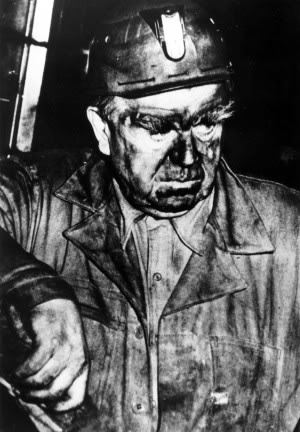
UMWA president John L. Lewis is pictured leaving the Orient 2 Mine the day after a massive explosion killed 119 miners.
“Necessary legislative steps would prevent these recurring horrors,” Lewis said. “They are totally unnecessary and can be prevented. Unless all mines are forced to comply with the safety codes of the Federal Bureau of Mines, the mining industry will continue to be a mortician’s paradise.”
Exactly two months later, on Feb. 21, 1952, Lewis testified before the U.S. House of Representatives Subcommittee on Mine Safety, and once again used the Orient 2 explosion as an example that mining laws must be improved.
Lewis said in part: “On Dec. 21, 1951, at the Orient 2 Mine, 119 men were killed. Their average age was 40.9 years old, the youngest was 19 and the oldest was 64. Aside from the human values that were destroyed in this explosion, the community and the state suffered a monetary loss in the contribution that those men would have made had they been permitted to live; or if their lives had been safeguarded; or if one coal company had carried out the provisions of the existing federal code of safety, promulgated by the U.S. Bureau of Mines. That is all, in the judgment of experienced mining men, that would have been necessary to have saved the lives of those 119 men and avoided the disruption of the lives of 175 children growing up to manhood and womanhood.”
Lewis didn’t mince words when he spoke before Congress offering a stinging rebuke about mining laws and practices.
“The Orient explosion was preventable, preventable in the judgment of the U.S. Bureau of Mines, as testified here by its able director. The Orient explosion was preventable in the judgment of every man in the industry that has knowledge of sound mining practices. So, the record runs on, explosion after explosion through the years. Management was at fault in the West Frankfort explosion. It failed to take proper precautions in the face of abnormal conditions that intensified the hazard. Management didn’t take those steps. As a matter of fact, I think it is conceded by those qualified to speak on the subject that every mine explosion and disaster we’ve had in our country since 1940 would have been prevented if the existing code of safety had been enforced.”
The legendary union boss concluded his comments with a powerful and graphic description of what took place in Franklin County in the aftermath of the explosion.
“And the mining industry continues to be a mortician’s paradise. I just watched 119 funerals in two days in Franklin County – 119 funerals in two days! Can you imagine anything more heart-rendering, more soul- stirring? 119 funerals in that little county in two days! They went to work, the last shift before Christmas … and many of them were brought home to their loved ones in rubber sacks – rubber sacks! Because they were mangled, and shattered and blown apart and cooked with methane gas, until they no longer resembled human beings. And the best the mortician could do was put them in rubber sacks with a zipper. And then, for a Christmas present in Franklin County, 119 families could look at rubber sacks in lieu of their loved ones.”
In the holiday classic “A Christmas Story” the main focus of the movie is the desire and outright obsession of young Ralphie to convince his parents, Santa Claus or anybody else that would listen that he needed a Red Rider BB gun for Christmas.
“You’ll shoot your eye out,” you’ll remember is what poor Ralphie was met with at every turn.
Substitute a gold Schwinn stingray bicycle for that Red Ryder BB gun and during the weeks leading up to Christmas in 1963 I could have very well been Ralphie (minus the horn-rimmed glasses).
About two months before Christmas that year I was with my dad at a West Frankfort business where he was getting tires put on an old truck that he used to haul coal. Along with tires the store sold a variety of items including bicycles.
As I wondered around that day I spotted a bicycle that was unlike any I’d ever seen. It was a Schwinn stingray, metallic gold and it had what was called butterfly handle bars and a banana seat. The front tire was a little smaller than the knobby tire on the back. It had chrome all over it and a price tag of $39.95. In order to appreciate that price you have to think in 1963 dollars. That $39.95 was more than my dad made in two days working in the mines.

As I stared at the bike I learned an early lesson in life – there is such a thing as love at first sight.
Before we left I coaxed my dad over to the bicycle to show him. He casually glanced at it, obviously not nearly as impressed as I was and then quickly burst my bubble.
“That’s too much money for a bicycle,” he said matter-of-factly, and then abruptly turned and walked away.
Did his seemingly uncaring attitude faze me? Of course not and in fact it spurred me on to scheme and plot my strategy. In the following days I concocted every reason imaginable why I should have that bike and brought it up on a daily basis. And for every good reason I had my dad gave me the same stern answer.
“That’s too much money to pay for a bicycle,” he would say and then promptly change the subject.
And the harder I would persist the more short and abrupt were his answers. I was in a gloomy mood two days before Christmas when I gathered with a group of fellow heathens, as we did nearly everyday, to play basketball. Once again, keep in mind that this was during an era when kids actually played outside. The house where we were playing was about four blocks from where I lived, but was located directly across the street from my Aunt Thelma. Shortly after I arrived at the pick up game one of my friends told me that he had seen my dad and mom at my aunt’s house earlier in the day.
“I couldn’t see exactly what they were doing but they were putting something in her garage,” he said.
Realizing even at that young age that curiosity killed the cat I still couldn’t stand it and had to do a little investigating. Shortly before dark that night I walked down the alley and with the help of a milk crate looked in the window of the garage.
And what to my wondering eyes should appear … but that gold Schwinn stingray bike. I was elated and excited and joyous and scared to death – all at the same time. You see, I’ve never been able to lie about anything in my life without my eyes giving me away, so I had to pretend like the events of that afternoon never happened and then turn in an Academy Award acting performance on Christmas morning.
Much like Ralphie and that Red Rider BB gun, my love for that gold Schwinn new no bounds. I had to pull it off.
I’m certain I had a little extra spring in my step in the final days leading up to Christmas morning when we opened our presents but I managed to contain my enthusiasm and keep my mouth shut (which was no small task for me even back in those days).
On Christmas morning I bounded out of bed and turned in an acting performance that was, if I say so myself, simply superb. I hooted and hollered, yelled and screamed and within a matter of minutes I was riding that spectacular bicycle down the street with the cold December air hitting me in the face. It really does seem like it was just yesterday!
Of course, during that fateful Christmas in 1963 I also learned an important lesson that I filed away for future reference with my own children. Parents should never, ever hide Christmas presents in a building with a window because you can never tell when some nosy kid is lurking in the shadows.
More than 55 years later I can still recall what a wonderful Christmas I had that year. There has never been, or will there ever be a better Christmas present than that Gold Schwinn Stingray with the butterfly handlebars and banana seat!
From my little corner of the world to yours … Merry Christmas!
By Jim Muir
Christmas is traditionally a time for joyous celebrations, family gatherings and wide-eyed children who are enthusiastically anticipating the arrival of Santa Claus.
However, for many others the Yuletide season is a test of strength and endurance while trying to find a new-normal in dealing with the death of a loved one and a central figure in holiday celebrations.

Brenda LeVault
The latter is the case for the Tom LeVault family as they attempt to come to terms with the loss of family matriarch Brenda LeVault, who passed away on October 18, 2019 from chronic respiratory failure and pneumonia. Only 72 years old when she passed, Brenda and Tom, who lives in rural Sesser, were married for 56 years and are the parents of four children, son Larry and daughters Tawana, Jackie and Lisa. The couple also has 11 grand-children and two great-grandchildren.
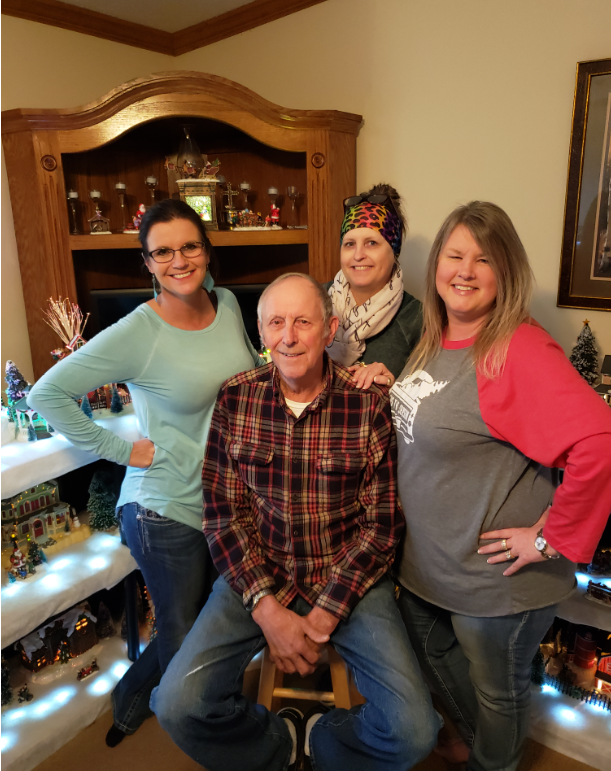
Tom LeVault (front) surrounded by daughters (left to right) Jackie Halley, Lisa Rapp and Tawana Pitchford.
While Brenda is fondly remembered for many things, her big personality and even bigger love of all-things Christmas are near the top of the list.
A passage from her obituary, written by her family, shows the impact she had on her loved ones. It reads:
The world became a little quieter with her passing. Her sassy, fierce, no-holds barred approach meant she left this world in true ‘Brenda Fashion’ – her way and on her terms. You never had to question where you stood with her. She loved deeply and openly. She was everyone’s biggest cheerleader. She never turned those in need away. Her door was always opened and you were always warmly welcomed. She was the only women we knew who could take a meal for a few, and turn it into a meal for plenty. Her children’s friends became her kids. Brenda played many roles, but her favorite was just being Nanny to her grandchildren.
As late November rolled around on the calendar the LeVault family was faced with the decision about how to handle Christmas. One of Brenda’s passions about her favorite holiday involved a huge ‘Christmas Village’ – a village that had taken on a life of its own throughout the years. What started for the family 20 years ago with three small pieces has now evolved into a three-level village that covers three walls of a large room and has more than 1,000 pieces and moving parts.
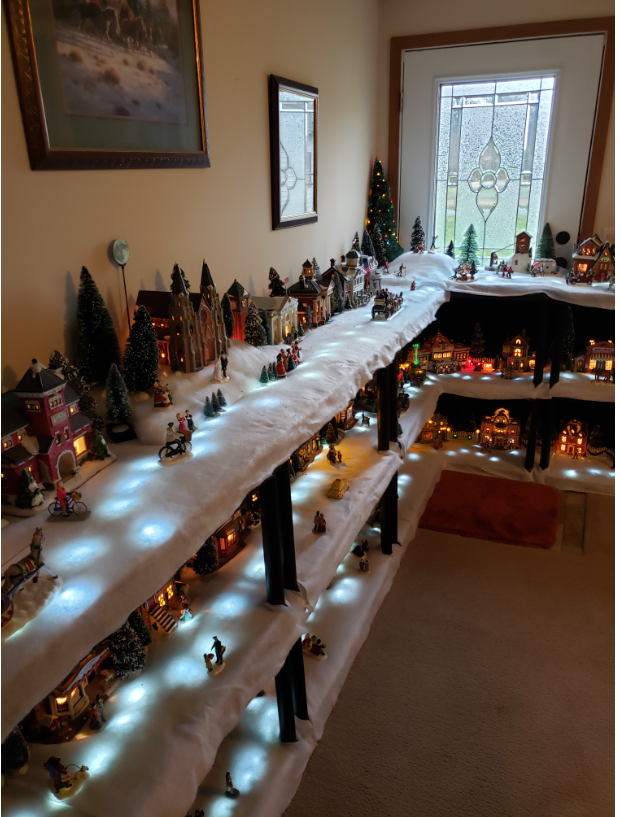
Following Brenda’s death, Tom said he had no intention of tackling the annual project of putting the village out.
“My first reaction was that I was not going to put the village up this year, but when I mentioned that I got three good ‘butt-chewings’ (pointing at his three daughters) and it was sternly suggested that … ‘yes we are putting the village up,’” said Tom, a retired coal miner and farmer.
Waving his arm around the room at the mammoth Christmas Village display, Tom added: “And you can see who won that discussion.”
It’s fitting that putting the village together each year is a family affair because many of the purchases of the many different items on display were also a family affair.
“We have all been shopping and we would see something for the village and call mom to see if she had this piece or that piece,” said Tawana. “It’s been a family affair since the beginning.”
While all three daughters admitted that they are still trying to come to terms with the grief of losing a strong influence in their lives, they all agreed that the village had to go up this year.
Click on link to see video of LeVault Christmas Village.
“It’s tough this year because Mom is not here to boss everybody around,” said Tawana with a laugh. “But, it has been a help to me to see the Christmas village come to life again. I don’t think any of us really wanted to do it … but we knew we had to do it.”
Jackie said if she acted on her true feelings, she could easily “skip Christmas this year.”
“I know that none of us wanted to put the village up this year, we really didn’t have the heart to do it,” said Jackie. “But, we also knew we had to do it. It’s funny, but seeing the Christmas village back up again has helped me. And I know that my mom would be happy it’s up.”
Lisa said she shared the same feelings as her two sisters.
“It’s one of those things in life that you don’t want to do but you know you have to do,” Lisa said. “It has helped me to try and get through December and Christmas, but it’s not easy for me. I know my mom would be happy and I’m happy to help carry on a family tradition.”
The meticulous detail of the village is nothing short of amazing, with a city section, a country section, a carnival, movie theater, churches from every denomination, museums, town hall buildings, people, animals and everything imaginable in between.
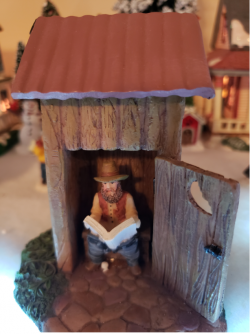
Tom pointed out Brenda’s favorite piece, a deer nose to (carrot) nose with a snowman and his favorite, an ‘outhouse’ with the door swung open wide and a man reading a newspaper.
“Every piece has a story behind it and a memory,” Tom said.
To guarantee that the village has the same look every year the LeVault family even put together a scrap book with pictures and details of where every piece is supposed to be. For example one picture might be marked Section A, Row 2 to show exactly where that piece goes while another is marked Section K, Row 3. The family estimated it would take one person working all day two weeks to assemble and put the entire village together.
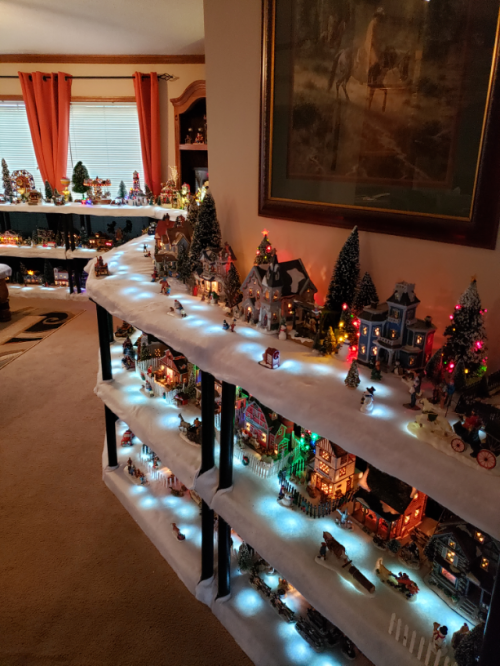
Pointing to a large couch near the recently-assembled village, Tom recalled better days.
“I can’t tell you the hours that me and Brenda sat on that couch in the dark with just the lights of the village,” he said. “It is just beautiful at night.”
With the village completed for this year father and daughters are now tackling what was referred to as: Brenda’s 9-foot Christmas tree.
“There’s one place in the house where it will fit and Brenda had to have a 9-foot Christmas tree for that spot,” Tom said. “That will be the next project, and that would make her happy.”
While the village and the tree will be completed there is one area of Christmas where all three daughters and husband Tom agree that they can not meet Brenda’s standards.
“She bought presents and then she bought more presents,” said Tom. “She had one room here at the house that she would stack presents after they were wrapped and it would be full and head-high by Christmas. It was nothing for her to go through 100 rolls of wrapping paper.”
Tom encouraged family and friends to bring their children to see the village on full display. Family members will be on hand Sunday, December 8, 2019 from 3 p.m. to 8 p.m. for anybody wanting to get an up-close look at the Christmas village. The address is 7292 Peach Orchard Road, located southeast of Sesser.
“Nothing would make Brenda happier than to know that people are enjoying something she loved so much,” he said.
Tawana summed up the overall feeling for her family.
“We know she is in a better place and she is not struggling with her health,” she said. “We all know that Christmas will never be the same without her but seeing the village come to life, it just touches your soul. We know she’d be happy with what we’ve done.”
Lawyers for a former Illinois state employee are asking an appellate court for all of its judges to hear a case on a demand for a refund of union fees the U.S. Supreme Court said the employee was unconstitutionally forced to pay.
Here’s a link to the story at Illinois News Network.
Illinois farmers are still trying to fight the weather to get their crops out of the ground in what’s looking to be one of the most challenging years in recent memory.
Here’s the link to the story at Illinois News Network.
MARION — Wednesday classes were canceled at Marion High School so that the facility can be professionally inspected for bedbugs, indicated Marion Community Unit School District No. 2 in a message to parents posted to its Facebook page Tuesday evening.
Here’s a link to the story at the Southern Illinoisan.
MARION — The Harbory in Williamson County near Marion has been issued a state license for adult-use recreational cannabis sales starting Jan. 1.
Here’s a link to the story at the Southern Illinoisan.
Lawyers for a former Illinois state employee are asking an appellate court for all of its judges to hear a case on a demand for a refund of union fees the U.S. Supreme Court said the employee was unconstitutionally forced to pay.
Here’s a link to the story at Illinois News Network.
An 88-member task force missed a key deadline to deliver a report on how to reduce the state’s high property taxes, all but guaranteeing none of the group’s recommendations will be signed into law this year.
Here’s a link to the story at Illinois News Network.