‘Christmas ended that night’ — The 64th anniversary of the Orient 2 mining disaster

By Jim Muir
Christmas traditionally is a time for wide-eyed children, exchanging gifts and festive family get-togethers. For many, though, it also is a time that serves as a grim reminder of the worst tragedy in the history of Franklin County.

On Friday, Dec. 21, 1951, at about 7:35 p.m. a violent explosion ripped through Orient 2 Mine, located near West Frankfort, claiming the lives of 119 coal miners. The tragedy occurred on the last shift prior to a scheduled Christmas shutdown.  News of the tragedy spread quickly from town to town and hundreds of people converged on the mine to check on loved ones and friends.

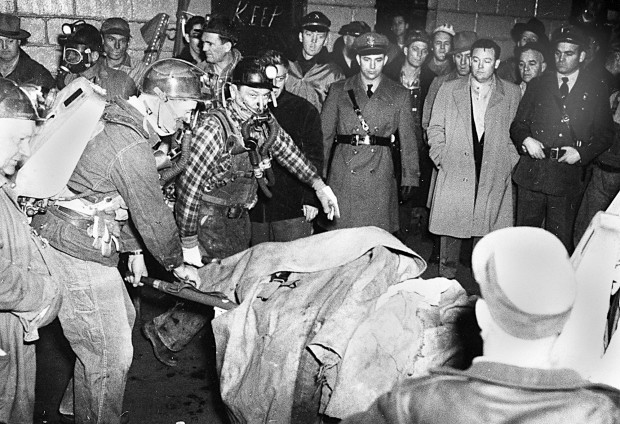
Rescue workers are pictured with one of the 119 miners killed on Dec. 21, 1951 in the Orient 2 explosion.

Rescue workers are pictured with one of the 119 miners killed on Dec. 21, 1951 in the Orient 2 explosion.

A basketball game was under way at Central Junior High School in West Frankfort, when the public address announcer asked that Dr. Barnett report to Orient 2 Mine, No. 4 Portal, because “there had been a catastrophe.”  There were about 2,000 people at the game, and nearly half of them left with Dr. Barnett.  News of the tragedy and massive loss of life drew nationwide attention. Both Time Magazine and Life Magazine featured accounts of the explosion and newspapers from throughout the country sent reporters to Franklin County to cover the holiday tragedy. Gov. Adlai Stevenson was at the mine the following day along with volunteers from the Red Cross and Salvation Army.  Those who arrived at the Orient 2 Mine immediately after reports of the explosion surfaced had no way of knowing that they would be a part of history and folklore that would be handed down from family to family for decades to come.

A Christmas  Miracle 

Rescue workers began entering the mine within hours of the explosion, clearing gas and searching for survivors.   What they met, however, was the grim reminder about the perils of mining coal and the force of methane-fed coal mine explosions. Locomotives weighing 10 tons were tossed about, timbers a foot thick were snapped like twigs and railroad ties were torn from beneath the rails. Rescue workers began recovering bodies of the 120 missing men shortly after midnight on Dec. 22.   As the hours passed, and body after body was recovered from the mine, it became apparent that it would take a miracle for anybody to survive the explosion and the gas and smoke that resulted.  In the early morning hours of Christmas Eve — 56 hours after the explosion — that miracle happened.

Benton resident Cecil Sanders was found on top of a “fall” barely clinging to life. Authorities theorized that Sanders, by climbing on top of the rock fall, miraculously found a pocket of air that sustained him until rescue workers arrived.  Sanders told authorities later that he was with a group of five men (the other four died) when they actually heard the explosion. He said the men tried to get out of the mine but were driven back by smoke and gas. Sander said later he had resigned himself to the fact that he was going to die, even scribbling a note to his wife and children on the back of a cough drop box. “May the good Lord bless and keep you, Dear wife and kids,” Sanders wrote. “Meet me in Heaven.”

Sanders, who died only a few years ago, reported in a book, “Our Christmas Disaster,” that rescue workers were amazed that he survived.

“My God, there’s a man alive,” Sanders later recalled were the first words he heard as he slipped in and out of consciousness. “They didn’t seem to think it was true. When they got to me I couldn’t tell who they were because they all had on gas masks. Rescue workers came back in a few minutes with a stretcher, gave me oxygen and carried me out of the mine. There’s no question it was a miracle.”

A Christmas  Never Forgotten  

Rescue workers and funeral directors were faced with a grim task during the 1951 Christmas holiday season.  Something had to be done with the scores of bodies that were brought up from the mine. And funeral homes throughout Franklin County — where 99 of the 119 fatally injured miners lived — would have to conduct multiple funerals; in some instances, six or eight per day.  A temporary morgue was set up at Central Junior High School where row after row of bodies lined the gymnasium floor. Brattice cloth, normally used to direct the flow of air in coal mine entries, covered the bodies.  The usual joyous Christmas season turned into a bleak pilgrimage for families from throughout Southern Illinois as they faced the task of identifying the charred remains of the miners. The last body was removed from the mine on Christmas night, completing the work of the rescue and recovery. In all, 252 men were underground at Orient 2 when the explosion took place — 119 died and 133 miners in unaffected areas escaped unhurt.

‘Christmas ended  that night …’     

Nearly every person in Franklin County was affected, either directly or indirectly, by the disaster. For some of those who lost loved ones in the Orient 2 explosion, the events of that Christmas are just as vivid in 2001 as they were in 1951.   Perhaps no story evolved from the tragedy that was more poignant than that of Geneva (Hines) Smith, the 26-year-old mother of two small children, who lost her husband, Robert “Rink” Hines in the explosion.  Smith, who later remarried, still brushes away a tear when she recalls the last words of her young husband before he left for work on that fateful Friday afternoon.

“He held our daughter Joann, she was 3 months old, and he put his face against hers and he said, ‘she looks just like me … doesn’t she?” Smith recalled. “Only a few hours later his sister came to the door and said there had been an explosion … and then we learned later that he’d been killed. The last thing I remember was how happy he was holding his daughter.”

Smith said a cruel irony involving the funeral also played out after her husband’s death.

“There was so many funerals that they had them early in the morning and all day until in the evening,” Smith remembered. “The only time we could have his funeral was at 8 p.m. on Christmas Eve. That was our fifth wedding anniversary and we got married at 8 p.m. … I’ll never forget that.”

Lyle Eubanks, of Mulkeytown, remembers distinctly his last conversation with his father Clarence, prior to the elder Eubank’s departure for work.

“He walked into the kitchen and got his bucket and then walked back into the living room and sat down on the couch,” Eubanks said. “He talked about it being the last shift prior to the Christmas shutdown and said if he didn’t need the money so bad he wouldn’t go to work that night — that’s the last time I talked to him.”

Eubanks said he identified his father’s body at the morgue.

“There was just row after row of bodies and they were covered with brattice cloth,” he recalled. “You just can’t imagine how horrible of a scene it was. I’ll never, ever forget what that looked like.”

Eubanks said the holiday season for his family and all of Franklin County came to an abrupt halt on Dec. 21, 1951.

“People took down their Christmas trees and outside ornaments after the explosion. It was almost like they didn’t want to be reminded that it was Christmas. Someone came to our house and took the tree, ornaments and all, and put it out behind a building in back of our house,” Eubanks said. ” Christmas in 1951, well, … Christmas ended that night.”

——————————————

‘It affected everybody …’

By Jim Muir
WEST FRANKFORT — Fifty years ago, Jim Stewart was a 25-year-old coal miner working at the Orient 1 Mine near Orient. His father, Silas, was working in the nearby Orient 2 Mine.  On Dec. 21, 1951, just past 7:30 in the evening, while both were at work, an explosion of methane gas tore through Orient 2 Mine and took the lives of 119 coal miners. Silas Stewart was among the victims.

The elder Stewart was working on the last shift before a scheduled Christmas shutdown.

“I didn’t know about it until I had finished my shift,” Stewart said. “It didn’t matter who you talked to, they had either lost a relative, a neighbor or a friend. It affected everybody.”

In the wake of the tragedy, Stewart remembers the generosity of total strangers.

“Funds were established for the victims and their families and contributions poured in from across the United States. Those were pretty hard times anyway and there was just a great outpouring of help,” he said.

And Stewart remembers the despair of that Christmas.

“It was just a terrible, terrible time,” he said. “I remember that some of the funerals couldn’t be held because there wasn’t enough caskets for all the victims.

“My father was buried on Christmas Day, so there’s never been a Christmas go by that you don’t relive that.”

Jack Bigham of West City was just completing his first year of employment at Orient 2 and was underground when the explosion occurred.

“I was in the 15th East section of the mine working with Roland Black. We hadn’t been in there very long and the power went off, so I called out to see what was wrong,” Bigham said. “They wouldn’t tell us exactly what was wrong, they just told us to walk to the old bottom. I remember when we got to the bottom the power was still off and we had to walk the stairs out. We didn’t find out what was wrong until we got on top.”

Bigham, who is now retired after a 38-year career as a coal miner, went back to work at Orient 2 after it reopened and worked an additional eight years at the mine. He said it was difficult to go back.

“I think about it quite often — of course, even more at this time of the year when it’s near the anniversary,” Bigham said. “I know that I was just very lucky to be in another section of the mine that night.”

Curt Gunter, 57, of Benton, a 25-year veteran of the Southern Illinois coal industry, was 7 years old when his father, Harry “Tater” Gunter, was killed.

“There are things about it that are hazy, like I don’t remember my dad’s funeral at all,” Gunter said. “But the thing that stands out in my mind the most is that, looking back through the eyes of a boy, it seemed like there was a big, black cloud just hanging over everything because so many people were involved. When you grow up with a memory like that at Christmas, well, you don’t ever forget it.”
————————————————-

Legendary UMWA President John L. Lewis was at Orient 2 the day after the explosion 

By Jim Muir

UMWA President John L. Lewis was on the scene at Orient 2 the day after the explosion and the legendary union boss went underground at the ill- fated mine while rescue operations were still under way.

Lewis, known for his no-nonsense approach with coal operators and his untiring devotion to improve conditions for union miners, was visibly shaken when he left the mine. He wasted little time leveling an attack on mining laws that he said needed to be revised.

UMWA president John L. Lewis is pictured leaving the Orient 2 Mine the day after a massive explosion killed 119 miners.

UMWA president John L. Lewis is pictured leaving the Orient 2 Mine the day after a massive explosion killed 119 miners.

“Necessary legislative steps would prevent these recurring horrors,” Lewis said. “They are totally unnecessary and can be prevented. Unless all mines are forced to comply with the safety codes of the Federal Bureau of Mines, the mining industry will continue to be a mortician’s paradise.”

Exactly two months later, on Feb. 21, 1952, Lewis testified before the U.S. House of Representatives Subcommittee on Mine Safety, and once again used the Orient 2 explosion as an example that mining laws must be improved.

Lewis said in part: “On Dec. 21, 1951, at the Orient 2 Mine, 119 men were killed. Their average age was 40.9 years old, the youngest was 19 and the oldest was 64. Aside from the human values that were destroyed in this explosion, the community and the state suffered a monetary loss in the contribution that those men would have made had they been permitted to live; or if their lives had been safeguarded; or if one coal company had carried out the provisions of the existing federal code of safety, promulgated by the U.S. Bureau of Mines. That is all, in the judgment of experienced mining men, that would have been necessary to have saved the lives of those 119 men and avoided the disruption of the lives of 175 children growing up to manhood and womanhood.”

Lewis didn’t mince words when he spoke before Congress offering a stinging rebuke about mining laws and practices.

“The Orient explosion was preventable, preventable in the judgment of the U.S. Bureau of Mines, as testified here by its able director. The Orient explosion was preventable in the judgment of every man in the industry that has knowledge of sound mining practices. So, the record runs on, explosion after explosion through the years. Management was at fault in the West Frankfort explosion. It failed to take proper precautions in the face of abnormal conditions that intensified the hazard. Management didn’t take those steps. As a matter of fact, I think it is conceded by those qualified to speak on the subject that every mine explosion and disaster we’ve had in our country since 1940 would have been prevented if the existing code of safety had been enforced.”

The legendary union boss concluded his comments with a powerful and graphic description of what took place in Franklin County in the aftermath of the explosion.

“And the mining industry continues to be a mortician’s paradise. I just watched 119 funerals in two days in Franklin County – 119 funerals in two days! Can you imagine anything more heart-rendering, more soul- stirring? 119 funerals in that little county in two days!  They went to work, the last shift before Christmas … and many of them were brought home to their loved ones in rubber sacks – rubber sacks! Because they were mangled, and shattered and blown apart and cooked with methane gas, until they no longer resembled human beings. And the best the mortician could do was put them in rubber sacks with a zipper. And then, for a Christmas present in Franklin County, 119 families could look at rubber sacks in lieu of their loved ones.”

Valier man dies Monday morning in single-vehicle accident

A 75-year-old Valier man was killed Dec. 14 in a single-vehicle accident in Franklin County.

Franklin County Coroner Marty Leffler said the name of the victim is not being released at this time. Leffler pronounced the victim dead a the scene at 10:35 a.m. on Monday.

Leffler said the victim was driving a passenger car that was traveling south on Jefferson Street in Valier, just north of Izaac Walton road, when it appears it left the road way went up an embankment, through an electric fence into a cow pasture where it struck struck a tree.


Leffler speculated that the driver of the vehicle possibly had some type of medical issue occur, causing him to leave the roadway and the vehicle come to a rest after impact with a tree. An autopsy is scheduled for Tuesday afternoon.

The Franklin County Sheriff Department is handling the crash reconstruction and investigation.

No other information is available at this time. The name of the victim will be released at noon on Tuesday.

This is the 18th motor vehicle fatality in Franklin County this year.

Governor Rauner blocks Syrian refugees from entering Illinois


SPRINGFIELD – Governor Bruce Rauner has issued the following statement regarding Illinois’ acceptance of Syrian refugees after the terror attacks in Paris:

“Our nation and our state have a shared history of providing safe haven for those displaced by conflict, but the news surrounding the Paris terror attacks reminds us of the all-too-real security threats facing America. We must find a way to balance our tradition as a state welcoming of refugees while ensuring the safety and security of our citizens. Therefore, the state of Illinois will temporarily suspend accepting new Syrian refugees and consider all of our legal options pending a full review of our country’s acceptance and security processes by the U.S. Department of Homeland Security.”


Rauner: Send state money to mayors, lottery winners

Gov. Bruce Rauner indicated today he’ll agree to send some long-awaited state money to mayors and lottery winners who have been begging for it.


Here’s a link to the story in the Daily Herald.

Rauner reverses course on cuts to child care, disability services

Republican Gov. Bruce Rauner, under fire from Democrats and their allies for cuts to popular social service programs, moved to lift those political pressure points Monday from a broader effort to win his pro-business, union-weakening legislative agenda.

Here’s the link to the story in the Chicago Tribune.

One person, $50,000 taxable income leaving Illinois every 7 minutes

(From KFVS-12)

More and more people are moving out of Illinois and it’s leaving quite the financial burden for the state.

According to an Internal Revenue Service report, Illinois lost 81,000 people and $4.1 billion of annual taxable income in 2013.

According to that report, that’s one person and $50,000 in taxable income that left the state every 6.5 minutes just two years ago.

And with the budget impasse Illinois is currently in, some people say it’s only creating more damage to the state’s economy.

“What’s going on with the budget crisis in this state is hurting our state’s economy,” director of the Paul Simon Public Policy Institute, David Yepsen said. “It creates business uncertainty, we know this and so this budget impasse we have is really hurting our state’s economy.”

According to the illinoispolicy.org, since the income-tax hike started in 2011, Illinois continues to see a rise in numbers of people and money leaving the state.

Yepsen said there are many factors that play into why this is.

“There are lots of reasons, they are complicated, but for some people, one issue is the economy,” Yepsen said. “And the tax burden, and the opportunity the state provides, and Illinois’ got some problems on those fronts.”

According to the article, in 2011, 49,728 residents left the state along with $2.5 billion. In 2012, that number grew to 66,922 residents and $3.8 billion. And by 2013, 81,117 residents left the state along with $4.1 billion.

“I think some people aren’t getting their money’s worth out of the taxes that they have. Some of the fastest growing, best places to live have relatively high taxes,” Yepsen said. “In a state like Illinois, with the budget stalemate and the corruption that we’ve had, a lot of people just don’t see where they get their money’s worth out of the government.”

The amount of people leaving comes as no surprise to some Illinois residents.

“I love Illinois, I love the climate, the people, I grew up here and I want it to succeed,” Richard Parrish said. “But given the politics in Springfield  and Chicago, it’s not working. They’ve run us in debt.”

“No I’m not, there’s a hopelessness in the state,” Lynn Mowry said. “And we’re in gridlock and we need to get it together.”

Yepsen said when people leave it has several different effects on the state.

“One is, it takes a job, and it moves it someplace else. It takes a talented worker, who pays taxes, who contributes to a community and they move it elsewhere. I think it also creates a bad psychological environment,” Yepsen explained. “People hear folks are leaving, businesses hear this, they worry about losing their workforce. It just creates a bad psychology. The state has to break this psychology and turn things around so people are more optimistic about building a future here.”

Yepsen said in order say in order to move forward, state house politicians need to resolve their budget impasse.

“Once they resolve the budget impasse and get a budget, we still have about five years-worth of spending cuts and revenue increases in order to dig our way out of the worst fiscal crisis in the state’s history,” Yepsen said. “So this is going to take some time to resolve.”

Political standoff hits hardest in state’s poorest counties

CAIRO — The only public health clinic in Illinois’ poorest county is in a former synagogue off a largely abandoned main street, a bright spot with multicolored windows where seniors can get flu shots and moms get help feeding their kids. But today the lights are off and the doors locked. A sign on the door apologizes for the inconvenience: Because of the impasse over the state budget, we are only open on Wednesdays.

Here’s the link to the story in the Springfield State Journal-Register.

Coach Kill taught more lessons about life than football

(EDITOR’S NOTE: Citing health reason Jerry Kill retired Oct. 28, 2015 as football coach at Minnesota. Reaction was swift and heartfelt concerning the impact the beloved coach left on players during every step of his remarkable coaching career. This is a story that appeared  in Southern Illinois Sports Connection Magazine in January 2008 — one month after Kill left SIU for Northern Illinois. It was written by former SIU quarterback Joel Sambursky. I thought of this story as I watched Coach Kill’s emotional press conference. It’s a wonderful tribute. I hope you enjoy. — Jim Muir)

By Joel Sambursky

To many Saluki fans, December 13, 2007, the day Jerry Kill accepted the job as the head football coach at Northern Illinois University will be the day that marks the end of an unbelievable coaching era in Saluki football. But to one Saluki fan, and former player, the departure of Coach Kill means much more.

Outside of my mother and father, Coach Kill has done more for me than any other person on this planet. He has taught me how to go from being (using his words) “a long-haired hippie quarterback” to becoming a man. I don’t discount the knowledge I obtained from my brilliant professors when studying for my undergraduate or master’s degree, but it is hard to compare to the life lessons I learned on and off the football field from Coach Kill.

kill sambursky

Coach Jerry Kill and quarterback Joel Sambursky during their SIU days.

One of those lessons came on a horribly hot day at a work out session in 2002. We had just come off a one-win football season, and Coach Kill recognized the team lacked any sort of genuine leadership. At that time I was competing for the starting quarterback position and as a freshman I believed I had what it took to be the leader that the coaches desperately needed and the team desperately wanted. However there was one problem; that year, my red-shirt freshman year of college, I didn’t have a proper perspective of what leadership was all about.

After some intense lifting, we had just finished what we expected to be our last running drill, when Coach Kill blew his whistle and told us to get on the goal line. He thanked us for the hard work, but said he wanted us to do a hundred yards of bear crawls because he wanted to see who, if anyone would give up on his teammates. Bear crawls are when you get on your hands and feet, and without touching your knees, crawl across the field. Now keep in mind for a guy like me that weighed 185 pounds bear crawls are tough, but imagine how hard they are for a 330-pound offensive lineman.

Coach Kill blew his whistle and we were off doing our bear crawls. We finished the hundred yards and then turned to cheer on the “big boys” who were lagging behind. After they finished, Coach Kill told us to get back on the goal line and do it over. So we did it again. And after we finished, he put us back on the goal line and we did it again. All while Coach Kill is yelling behind us “who is going to be the guy…who is going to be the guy who gives up on his teammates … I want to know who it’s going to be because if he gives up now, he’ll give up in the fourth quarter.” At this point my hands were bleeding because of the blisters developing on them from the scorching hot turf. I was in every way exhausted, delirious, and begging God to bring all this to an end, but like my teammates I didn’t stop. I didn’t want to be the guy Coach Kill was talking about.

After we cheered the “big boys” across the finish line, Coach Kill told us to get on the line and do it one last time. He told us he wants to know who he can trust in the fourth quarter. With what felt like God’s help I managed to finish the hundred yards of bear crawls, and as my teammates and I had done before we began cheering for the “big boys.” One by one, the offensive and defensive lineman started crossing the finish line, while Coach Kill increased his fiery rhetoric.

Finally everyone finished except for one guy, Brian Akins, also known as “Big B.” Brian was 6-feet-4 and easily over 300 pounds. He was locked up at midfield unable to take another step, but refusing to go down to his knees. The entire team started to gather around him, cheering, encouraging, and hoping to help get Brian across the finish line. He started to take one step at a time, stopping occasionally in agony. Our cheers grew louder, while Coach Kill yelled: “Don’t give up on your teammates Brian … don’t you do it.”

Brian made it to about the twenty five yard line when Coach Kill blew his whistle. He looked at all of us who had gathered around Big B, and said, “We have no leadership on this team. You guys think you are leaders. You think being a leader is sitting off on the sideline cheering your teammates on?” Coach Kill looked at Big B, and told him to get on his back and he physically carried him across the finish line.

“That is what real leadership is all about,” Coach Kill told us.

That day I learned that true leadership isn’t just encouraging a friend in need, but putting them on your back and carrying them across the finish line when they are struggling. Coach Kill was teaching us all something that we will remember long after our playing days would be over; a lesson that had more to do with life than football.

What is most fascinating is my stories really aren’t unique. The stories I share are simply included on a long list of others, embedded on the hearts and minds of every young man who has played for Coach Kill. Coach Kill values the game of life more than football games, and speaks more about the fundamentals of life than the fundamentals of football. The departure of Coach Kill is going to be tough for many players, fans, and friends in Southern Illinois. But at the end of the day, I am just excited for the next “long-haired hippie quarterback” that steps into Coach Kill’s program, and leaves a different man.

Because that’s really what it is all about.


The City of Sesser says ‘In God We Trust’

By Jim Muir
The City of Sesser is saying a lot these days in just a few words — only four words to be exact.
City commissioners, acting on a recommendation by Mayor Jason Ashmore, recently approved a measure to put “In God We Trust” decals on all city -owned police cars. An enthusiastic group of onlookers and supporters gathered recently at Sesser City Hall when the decals were placed on the vehicles.
“It’s a very troubling world that we live in and we have witnessed a lot of tragedies that have involved police officer fatalities,” said Ashmore. “We decided to put the decals on our police vehicles to lift the spirits of our community and to honor our country and our national motto.”
sesser pd 013

IN GOD WE TRUST’ — Pictured following the installation of the first ‘In God We Trust’ decal is (l-r) Sesser police officer Christopher Roeder, Mayor Jason Ashmore, Jefferson County Sheriff Travis Allen, Jefferson County Chief Deputy Clint Taylor, Chief Ryan White and detective Ryan Morgan.

Ashmore pointed out that the decals come at no expense to taxpayers — they were donated by Freestyle Graphic, of Benton, and placed on the vehicles by Sesser Auto Body.

“I feel this is one way to let our officers and the community know we are one team,” Ashmore said. “We have a great community and a great police department and I believe this has really brought the community together.”
Cory Bolen, an employee of Sesser Auto Body, worked with painstaking care to install the decals.

Cory Bolen, an employee of Sesser Auto Body, worked with painstaking care to install the decals.

The move by Sesser officials to place the decals on all vehicles follows similar action taken only a few weeks ago by the Jefferson County Sheriff’s Department. In fact, Ashmore noted that he spoke with Sheriff Travis Allen, prior to moving forward. The Sesser mayor invited Sheriff Allen to the event this week, an invitation that was readily accepted.
sesser pd 012“Today was a very proud day for me,” Sheriff Allen said following the placement of the decals on Sesser squad cars.  “I am so proud of Mayor Ashmore and Police Chief Ryan White! This is about honoring our country and our national motto. This is not a Democrat thing, this is not a Republican thing. This is Americans standing up for our country.”

RLC Board highlights: FY 2016 budget adopted, tax levy determined


The board adopted the final Fiscal Year 2016 budget, which was provided in tentative form at the August board meeting. A public hearing on the budget was held at 6 p.m., prior to the regular board meeting. There were no comments from the public.

In a related action, the board accepted the 2015 tax levy (payable 2016). The levy represents a slight increase – 2.74 percent – over last year. The Corporate and Special Purpose levy went from $3,083,318 last year to $3,218,520 this year, a increase of 4.39 percent. The Debt Service levy dropped from $1,807,794 last year to $1,806,469 this year, a decrease of 0.07 percent. The total of the two levies rose slightly, from $4,891,112 last year to $5,024,989, an increase of 2.74 percent.

Because the total of the proposed Corporate and Special Purpose and Debt Service levies is not greater than 105 percent of last year’s levy, no Truth in Taxation hearing is required.

Unmanned Aircraft Systems curriculum approved, sent to ICCB for action

The board approved a new Unmanned Aircraft Systems (UAS) curriculum as well as several new classes Tuesday and authorized their submission to the Illinois Community College Board for action. The UAS curriculum is designed to provide not only the hands-on skills to operate unmanned aircraft, or drones, but also the cognitive information which will allow them to understand and operate within federal and state guidelines. It will prepare students to program the unmanned aircraft to operate autonomously while collecting geospatial data.

The curriculum consists of a nine-credit-hour occupational certificate made up of three new courses, also approved Tuesday: Intro to Unmanned Aircraft Systems; Advanced Unmanned Aircraft Systems; and Unmanned Aircraft Systems Law and Test Prep.

In addition, two new business courses – Entrepreneurial Skills and Business Functions – received similar approval, as did the Trauma Nursing Core Course. A new online Statistics course also was given approval for development.

RLC Foundation Children’s Center set to expand

The Rend Lake College Foundation Children’s Center will soon be growing along with the children for whom it provides care, thanks to funding through the RLC Foundation. The board granted permission to advertise for bids to build an addition on the north end of the center. The 1,526-square-foot addition will include a large open floor space for gross motor skill activities, a children’s library with half-height walls for monitoring the children, a restroom, two storage closets and a water cooler. The addition will be connected to the existing building via a small vestibule / corridor with direct access to the playground.

The total estimated cost for the project is $326,255, with construction anticipated to begin in February 2016. In a related action, the board granted permission to submit to ICCB the Locally Funded New Construction Application Form.

South Oasis roof, sidewalk PHS project gets go-ahead

The board granted permission to submit to the Illinois Community College Board a Protection, Health and Safety project to replace the South Oasis roof and sidewalk and to bid the project once approved.

Applied Science’s Jackson becomes Industrial Trainer

The board employed Matt Jackson as Industrial Trainer effective Oct. 1. Jackson currently is employed as the Illinois Green Economy Network Curriculum Coordinator. He holds Master’s and Bachelor’s degrees in Architecture from Southern Illinois University Carbondale and an Associate in Applied Science Degree in Architectural Technology from RLC. He recently earned his Occupational Safety and Health Administration and Manufacturing Skill Standards Council instructor certifications.

Title III Project Assistant Position changes accepted

The board accepted with regret the resignation of Morgan Harner, Title III Project Assistant, effective Sept. 15. “I want to give my sincere thanks for allowing me to not only hold my position as Title III Project Assistant, but to also participate in many committees, activities and events at Rend Lake College,” Harner said in her resignation letter.

In a related action, Heather Adams was appointed to the vacancy effective Oct. 1. She holds a Bachelor of Science Degree from Southern Illinois University Carbondale and an Associate in Arts in Elementary Education from RLC. She currently serves as a data entry clerk for RLC .

In other business, the board …

  • Approved board policy and procedure concerning enforcement of the Smoke-Free Illinois Act and the Smoke-Free Campus policy (first reading).
  • Approved revisions to board policy concerning the tenured / tenure-track faculty and staff seniority list (first reading) and non-compliance with directives during an emergency situation (first reading).

Mark your calendars …

  • Cruise Nights at the RLC MarketPlace, Mt. Vernon – 6-9 p.m. Friday, Oct. 2.
  • Fun Fest – Noon-3 p.m. Wednesday, Sept. 16, on campus.
  • 35th Annual RLC Foundation Golf Outing – Thursday, Sept. 17, Rend Lake Golf Course, noon shotgun start.
  • Warrior Fest – 9 a.m.-2 p.m. Saturday, Sept. 19, on campus.
  • RLC Art Auction, 5 p.m. Thursday, Sept. 24, Rend Lake Resort Great Room.
  • Upward Bound Banquet, 6 p.m. Tuesday, Sept. 29, Rend Lake Resort.
  • ACCT Annual Leadership Congress, Oct. 14-17, San Diego, Calif.
  • RLC Foundation Scholarship Banquet, 5:30 p.m. Monday, Oct. 12, Rend Lake Resort.
  • Free Certified Nurse Assistant Conference, 7:30 a.m. to 4 p.m. Friday, Oct. 16, RLC Theatre.
  • RLC Fall Open House, 5:30-7:30 p.m. Tuesday, Oct. 20, 2015, RLC Student Center.
  • Paramedic Accreditation Site Visit – Nov. 3-5.
  • RLC Foundation Annual Dinner, 6:30 p.m. Thursday, Dec. 3, Holiday Inn Mt. Vernon.
Benton, West Frankfort, Illinois News | Franklin County News